Tech Science Daily — September 21, 2026: 5-GHz Phone Chips, 4,500-Nit OLED Screens, and Chrome's Sixth Zero-Day

PcHybrid

Montreal, September 21, 2026 — Autumn tech season has arrived in full force. Tomorrow morning in Maui, Qualcomm opens the Snapdragon Summit and is expected to confirm the numbers that have already leaked: a smartphone processor whose fastest core clocks above 5 GHz for the first time in the industry's history. This week also brought a sobering reminder from Google that the browser sitting on almost every laptop and desktop we sell has just been patched against its sixth actively-exploited zero-day of the year, and Samsung Display quietly confirmed that its next generation of QD-OLED television panels will push peak brightness to 4,500 nits — a jump that changes how vivid highlights, sunlight glare and HDR content will look on our showroom floor next year. Behind each of these headlines sits real physics, real materials science and real silicon engineering, not just marketing copy. In today's edition of the PcHybrid tech briefing we scanned ten of the most significant technology stories of the past week, then chose the three with the deepest technical story to tell and the clearest connection to the laptops, phones, tablets and displays you can buy from us today.

Today's Tech Radar: The 10 Stories We Tracked

Here is the shortlist we compiled this morning from the past week of coverage, before narrowing it down to our three deep dives below.

# Story Why it matters
1 Qualcomm's Snapdragon Summit opens September 22, with the Snapdragon 8 Elite Gen 6 expected to break 5 GHz on a mobile CPU for the first time Sets the performance and efficiency bar for every 2027 flagship phone — and the laptops built on the same Oryon core
2 Google patches CVE-2026-85046, a V8 engine zero-day already being exploited in the wild — the sixth actively-exploited Chrome zero-day of 2026 Confirms attackers are still finding remote-code-execution bugs in the world's most-used browser engine
3 Samsung Display confirms 2026 QD-OLED panels reach 4,500 nits peak brightness, a 12% jump over last year's panels The biggest brightness gain in QD-OLED TV history is coming to Samsung and Sony television lineups
4 Attackers hijack MikroTik routers through internet-exposed SSH with no authentication required A reminder that the router at the edge of your network is as much a target as your PC
5 Thousands of D-Link routers found under the control of the "AryStinger" botnet Consumer networking gear remains the softest target for large-scale botnets
6 Nvidia's new "RTX Spark" PC chips push the GPU giant into CPU territory, rattling Intel and AMD's stock The three-way (now four-way, with Qualcomm) fight for the PC processor market intensifies
7 Meta confirms its in-house AI chip enters production this month, aiming to roughly double the company's AI computing capacity Another major buyer is reducing its reliance on merchant silicon from Nvidia
8 Qualcomm and Arm push further into data-center chips, challenging Nvidia and Intel on their home turf The Arm architecture that already dominates phones is now contesting the server rack
9 "Model fatigue" sets in as Anthropic, OpenAI, Meta and Google all ship new AI models within the same week The pace of frontier-AI releases is now arguably too fast for most users or businesses to track
10 September's smartphone launch wave crowds the calendar with the iPhone 18 Pro, Samsung Galaxy S26 FE, Xiaomi 18 Pro and more than a dozen other new phones One of the busiest phone-launch months of the year is reshaping the flagship and mid-range landscape at once

Three of these ten stories share a common thread that we think deserves the deepest treatment: they are all about the physical limits of computing hardware being pushed outward this week — clock speed in silicon, brightness in a display panel, and the attack surface of the software that sits between you and the internet. Below, we unpack each one, the engineering behind it, and how it should influence what you buy.

1. Breaking 5 GHz: Inside Qualcomm's Snapdragon 8 Elite Gen 6

Starting September 22 in Maui, Qualcomm's annual Snapdragon Summit will formally introduce the Snapdragon 8 Elite Gen 6 — but thanks to a Geekbench listing that surfaced from one of Qualcomm's own internal reference devices on September 10, we already know more about this chip than any Snapdragon flagship at this stage in past years. The listing showed a mobile processor with a prime CPU core running at 5.11 GHz, a first for any smartphone chip in the industry's history.

3D render of an AI processor chip on a circuit board
Qualcomm's Oryon CPU cores are the foundation of both its phone and laptop silicon. Photo: Igor Omilaev / Unsplash.

Why clock speed alone doesn't tell the story

Clock speed — measured in gigahertz, or billions of cycles per second — describes how fast a processor's internal clock ticks, and each tick lets the chip advance one step of computation. It is tempting to treat it as the whole story, the way horsepower is often treated as the whole story for a car engine. But a modern flagship chip is not one core running at one speed; it is a heterogeneous cluster of cores tuned for different jobs. The Snapdragon 8 Elite Gen 6 reportedly uses a 2+3+3 Oryon core layout: two "prime" cores built for the heaviest bursts of single-thread work (web page rendering, opening apps, the workload that makes a phone feel instantly responsive), three "performance" cores for sustained multi-threaded loads such as gaming or video editing, and three efficiency cores that handle everything else — background sync, notifications, sensors — at a fraction of the power draw. In the Geekbench listing, the prime cores ran at that record 5.11 GHz, the performance cluster at 4.03 GHz, and the efficiency cluster at 3.74 GHz. The headline number belongs to only two of the chip's eight cores; the other six are tuned for endurance, not records.

This is also why Qualcomm is, for the first time, launching two distinct flagship dies rather than one: the standard Snapdragon 8 Elite Gen 6 (internally SM8950) and a higher-tier Pro/Extreme variant (SM8975) that is the one setting the clock-speed record. Splitting the flagship tier in two lets Qualcomm sell a cheaper, still very fast chip to mainstream flagships while reserving the most aggressive binning — the manufacturing process of sorting chips by how well individual silicon dies tolerate high voltage and heat — for the very top of the market. It is the same logic Intel and AMD have used for years with unlocked "K" or "X" processor variants, now arriving in a phone chip.

The manufacturing story: TSMC's 2nm node

None of this clock speed is possible without a manufacturing process to support it, and both Gen 6 variants are built on TSMC's 2-nanometre (N2) process node. The "2nm" label doesn't literally mean any transistor feature measures two billionths of a metre — it is a marketing-derived generation name — but it does mark a real architectural shift: TSMC's N2 node is the company's first high-volume process to use gate-all-around (GAA) nanosheet transistors in place of the FinFET transistors that have powered every leading-edge chip since roughly 2015. In a FinFET, the gate — the electrode that switches the transistor on and off — wraps around three sides of a thin silicon fin. In a gate-all-around nanosheet transistor, the channel is reshaped into stacked horizontal sheets, and the gate material wraps completely around all four sides of each sheet. That extra control surface lets the gate shut the channel off more completely when the transistor is meant to be "off," which directly reduces a phenomenon called leakage current — power that a chip wastes even when it isn't actively switching. Less leakage at a given clock speed means a chip can either run cooler at the same performance or push clock speeds higher within the same thermal budget, which is exactly the trade Qualcomm appears to be making with the Gen 6 Pro's 5-GHz-plus prime core.

Process yield — the percentage of manufactured chips on a wafer that come out defect-free and usable — is the unglamorous but decisive variable behind any new node's success, because low yields mean high prices and constrained supply. Industry reporting from earlier this year pegged TSMC's 2nm yields at roughly 60–70%, compared with an estimated 55% for Samsung Foundry's competing process. That gap is a major reason Qualcomm, like most of the industry's leading-edge chip designers, has stayed a TSMC customer for its flagship silicon rather than dual-sourcing.

New tricks beyond raw speed: FlexCache, memory and thermal design

Alongside faster clocks, Qualcomm has reportedly built in a new cache technology called Oryon FlexCache, which allows the chip to dynamically reallocate cache memory — the small, extremely fast pool of on-chip memory that stores data a core is likely to need next — between cores depending on workload, rather than statically partitioning it. The standard Gen 6 pairs its CPU cluster with a shared 16 MB L2 cache and an Adreno 845 GPU (a six-slice design with 12 MB of dedicated graphics memory and 6 MB of system-level cache), while the Pro variant steps up to an Adreno 850 GPU with 18 MB of dedicated graphics memory — a reported 50% increase in GPU memory bus width and capacity over the previous Snapdragon 8 Elite generation. On the memory side, the standard chip supports LPDDR5X system memory and UFS 5.0 storage, while the Pro variant adds support for the newer, faster LPDDR6 standard alongside LPDDR5X, giving device makers a choice depending on cost and availability.

All of that extra performance generates heat that has to go somewhere, which is why the Pro variant reportedly introduces Heat Pass Block (HPB) technology: a dedicated heat-spreading layer built directly into the chip package, sitting above the silicon to pull heat out faster before it ever reaches the phone's own vapor chamber or heat pipes. This is the same engineering pattern the PC industry has used for a decade — better on-package heat spreading buys headroom for sustained clock speeds — arriving in a smartphone chip for the first time at this scale.

What this means for your next phone or laptop purchase

The Snapdragon 8 Elite Gen 6 will power flagship Android phones arriving over the next several months, but the more immediately useful takeaway for most shoppers is what this generation of Oryon-derived engineering already means for the devices on our shelves today. Qualcomm's Oryon CPU architecture — the same core design lineage, scaled up for a larger thermal envelope — already powers the Snapdragon X Elite chip inside Windows laptops such as our in-stock Microsoft Surface Laptop 7 15" (Snapdragon X Elite, 16 GB / 512 GB), which is why Windows-on-Arm laptops have posted some of the best battery-life-per-watt numbers in the Windows ecosystem this year — the same architectural philosophy of wide, efficient cores paired with dedicated efficiency cores for background tasks. If you want a taste of where Qualcomm's phone silicon is headed today, our in-stock Samsung Galaxy Z Fold7 (512 GB) already runs on an Oryon-based Snapdragon platform with prime cores clocked at 4.47 GHz — extremely close to this year's flagship territory, in a folding form factor, and with 12 GB of RAM to keep multiple apps resident across its dual screens. And if your priority is simply a reliable 5G phone at an accessible price rather than record clock speeds, the in-stock Samsung Galaxy A16 5G (128 GB) covers the fundamentals — a 6.7" Super AMOLED display and 5G connectivity — without asking you to pay for silicon most everyday tasks will never fully exercise. Flagship clock-speed records make headlines, but for the vast majority of buyers, the practical question is always the same: does the chip in front of you comfortably outlast the next two or three years of app updates? Every one of these three devices answers yes.

2. The Brightness Race: How Samsung Display Is Pushing QD-OLED to 4,500 Nits

Samsung Display has confirmed that its 2026-generation QD-OLED television panels will reach a peak brightness of 4,500 nits, up from the roughly 4,000-nit figure claimed for last year's panels — a 12% increase achieved, in the company's words, through "newly optimized organic materials" and by combining the maximum brightness contribution of each of the panel's red, green and blue sub-pixels. For a technology that only reached mass-market television screens a few years ago, this is a meaningful jump, and it is worth understanding exactly what is being measured and why it is hard to achieve.

Flat screen 4K television mounted in a bright modern living room
Peak brightness determines how vivid highlights look and how well a screen fights ambient light. Photo: Oscar Nord / Unsplash.

What "nits" actually measure, and why OLED brightness is hard-won

A nit is a unit of luminance — one candela per square metre — describing how much visible light a surface emits toward your eye. Cloudy daylight outdoors is roughly 1,000–2,000 nits; a sunny beach can exceed 10,000 nits. A television's peak-brightness rating tells you how convincingly it can reproduce a small bright highlight, like sunlight glinting off a car or a flash of muzzle fire in a film, against a darker background — and it is also what lets a screen remain watchable in a sun-filled room.

QD-OLED panels earn both halves of their name from two different pieces of physics working together. The "OLED" half is an organic light-emitting diode layer: a stack of carbon-based compounds that emit their own light directly when a current passes through them, pixel by pixel, which is why OLED screens achieve true per-pixel black — a pixel that is off emits no light at all, unlike an LCD panel where a backlight always leaks some light through even a "black" pixel. The "QD," or quantum dot, half is a layer of nanometre-scale semiconductor crystals sitting in front of the OLED emitters; quantum dots absorb light of one color and re-emit it at a different, extremely narrow wavelength determined by the physical size of the crystal, which is what gives QD-OLED its wide, saturated color gamut compared with a conventional white-OLED-plus-color-filter design.

The catch has always been brightness. Every OLED material degrades — loses efficiency and eventually shifts color — a little more with every hour it is driven, and blue OLED emitters in particular have historically been the shortest-lived and least efficient of the three color channels, which is why manufacturers are conservative about how hard they push an OLED panel's peak output: push too hard and you accelerate burn-in and shorten the panel's usable life. Samsung Display's claimed 12% brightness gain for 2026 is therefore not simply a matter of turning up a dial; it reflects genuine improvements in the organic emitter materials themselves — chemistry that emits more photons per unit of electrical current and per unit of degradation, which is the real bottleneck the whole OLED television industry is racing to solve.

Panel specification versus what actually ships in your living room

It is worth being precise about what the 4,500-nit figure represents, because it is a laboratory panel specification, not a promise about any specific television you can buy. Samsung Display's own figures distinguish peak brightness (4,500 nits, achievable only on a very small portion of the screen for a short duration, a measurement convention often called a "1% window") from full-screen brightness, which is far lower — around 450 nits, a tenth of the peak figure — reflecting the reality that no OLED panel can sustain its maximum output across the entire screen simultaneously without overheating or drawing more current than its power supply and thermal design allow. Independent measurements of this year's actual shipping televisions illustrate the gap between panel potential and finished product: reviewers at FlatpanelsHD measured a peak of 2,069 nits on Samsung's current-generation S95F television and 1,689 nits on Sony's Bravia 8 II — both QD-OLED panels from Samsung Display, both well under half of the panel's rated ceiling, because a finished television's brightness is also gated by its power electronics, cooling, and the manufacturer's own longevity targets. Extrapolating the same 12% improvement to next year's shipping TVs suggests calibrated peak brightness approaching roughly 2,500 nits — still a meaningful step up, but a useful reminder to treat any manufacturer's panel-level nit figure as a ceiling, not a delivered spec.

Why this matters for your next screen purchase

Samsung Display manufactures the QD-OLED panels used in both Samsung's and Sony's television lineups, so this generational jump will show up across multiple brands' 2027 model years rather than being exclusive to one. For shoppers deciding what to buy today, the practical guidance is to separate the marketing number from your actual viewing environment. If your room has controlled lighting — blackout curtains, evening viewing, a dedicated home theatre — the incremental brightness gains at the very top of OLED's range matter less than OLED's core advantage: perfect per-pixel black levels and essentially instant pixel response time, which is why our in-stock Asus ROG Swift PG27UCDM 27" 4K OLED gaming monitor remains an excellent choice for a desk setup or a dedicated media room today — you get the same fundamental OLED contrast advantage the 4,500-nit panels are built on, without waiting a model year. If your priority is instead a very large screen for a bright, sunlit living room where peak brightness and glare-fighting matter more than absolute black levels, a high-nit LED-LCD panel remains the more practical choice at today's prices; our in-stock LG 75" 4K UHD Smart LED-LCD TV delivers a genuinely large-format 4K picture without the price premium OLED technology still commands at that screen size. And for business, retail or presentation environments that need a screen running many hours a day in a well-lit space — a boardroom, a showroom, a reception desk — our in-stock Samsung QM85C 85" UHD commercial display is purpose-built for exactly that job, with a 500-nit, non-glare, 24/7-rated panel engineered for continuous daytime operation rather than a single OLED's cinematic peak.

3. Chrome's Sixth Zero-Day of 2026: What a "Type Confusion" Bug Actually Is

Google has patched CVE-2026-85046, a high-severity flaw (CVSS score 8.8) in Chrome's V8 JavaScript and WebAssembly engine that was already being actively exploited when the fix shipped — the sixth Chrome zero-day of 2026 to reach that grim milestone. The U.S. Cybersecurity and Infrastructure Security Agency (CISA) added the flaw to its Known Exploited Vulnerabilities catalog on September 4 and gave federal agencies until September 18 to patch, underlining how seriously government security teams treat an actively-exploited browser bug.

Red padlock resting on a black computer keyboard, symbolizing browser and endpoint security
Keeping browsers and operating systems patched remains the single most effective defense against zero-day exploits. Photo: FlyD / Unsplash.

Type confusion, in plain language

The vulnerability is described by researchers as a type confusion bug inside V8's compiler — the internal software component that translates the JavaScript running on a web page into machine instructions your CPU can execute. To understand type confusion, it helps to know that V8 tags every array in memory with an internal "map" that tells the engine exactly what kind of data the array holds and, crucially, how to interpret the raw bytes stored at each position — for example, whether a given array holds only small integers (a format called PACKED_SMI_ELEMENTS, optimized for size and speed) or a mix of arbitrary values including objects and floating-point numbers (PACKED_ELEMENTS, a more general and slightly slower format). The V8 compiler's job includes deciding, ahead of time, which of these representations an array will use, and generating optimized machine code on that assumption.

According to the security researcher credited with the technical analysis, CVE-2026-85046 lets an attacker trick the compiler into a state where an array is actually tagged as one type — PACKED_ELEMENTS — while the compiler's generated code still treats it, and the raw memory behind it, as though it were the other, incompatible type. That mismatch is the "confusion": the engine reads or writes memory using an interpretation that no longer matches what is actually stored there. Because JavaScript engines are built to be extremely fast, they skip many of the bounds- and type-checks a conservative language runtime would perform on every single access, trusting the compiler's earlier analysis instead — which is precisely why a bug at the type-analysis stage is so dangerous. Once that trust is broken, the flaw can be escalated by a skilled attacker into what security researchers call an "arbitrary read/write primitive": the ability to read or overwrite essentially any address in the browser process's memory, which is usually enough to build a chain that ends in full remote code execution, all triggered simply by getting a victim to load a booby-trapped web page.

Why this keeps happening — and why it's not unique to Chrome

It's tempting to read six zero-days in a single year as evidence that Chrome is uniquely troubled, but the more accurate framing is that V8, like every high-performance JavaScript engine (Apple's JavaScriptCore and Mozilla's SpiderMonkey included), is under constant, well-funded attack precisely because it sits at the intersection of two hard problems: it must run untrusted code — literally any JavaScript on any website you visit — at speeds competitive with compiled native software, and it must do so safely. Achieving that speed requires exactly the kind of aggressive, type-specialized compiler optimizations described above, and every such optimization is a new opportunity for a subtle logic error to open a security hole. Google's own transparency about these bugs — and the speed of its patch cadence, typically days from confirmed active exploitation to a shipped fix — is in fact one of the reasons Chrome, alongside other actively maintained browsers, remains a reasonable default choice, provided updates are actually installed.

A pattern across the whole network, not just the browser

This week's Chrome patch did not arrive in isolation. Security researchers also disclosed that attackers are hijacking MikroTik routers through internet-exposed SSH management interfaces that require no authentication at all, and separately confirmed that thousands of D-Link routers remain compromised by a botnet nicknamed "AryStinger." Taken together with the Chrome zero-day, the pattern is consistent: attackers are opportunistically exploiting whatever piece of your network sits with an unpatched, exposed, or poorly configured door — whether that door is a browser engine, a router's management interface, or an outdated firmware image — and are doing so at industrial scale using automated scanning rather than hand-picked, high-value targets. That should reshape how any household or business thinks about its risk: you do not need to be a specific target to be swept up in one of these campaigns; you only need to be running unpatched software with an exposed attack surface.

What you should actually do about it

The practical defense against a bug like CVE-2026-85046 has not changed in twenty years, even as the bugs themselves have grown more sophisticated: install browser and operating system updates promptly, and prefer devices and platforms that make that easy rather than optional. This is one of the most concrete, quietly important advantages of buying a current-generation business notebook rather than holding onto older hardware — modern Windows 11 machines such as our in-stock Microsoft Surface Laptop 7 13.8" (Intel Core Ultra 7, 32 GB / 512 GB) and our in-stock Lenovo ThinkPad T14s Gen 6 Copilot+ PC ship with current Windows 11 security baselines, hardware-backed credential protection, and full vendor support for the fastest possible security patch delivery — all of which meaningfully reduces the window during which a browser zero-day like this one can be leveraged against your business. If your organization is managing a fleet of laptops, routers or point-of-sale devices and you're not confident every one of them is current on firmware and patches, that audit is exactly the kind of engagement our team handles regularly — request a free quote from our team and we'll help you assess where your exposure actually is.

Reading the Three Stories Together

Pull back far enough and this week's three deep dives describe the same underlying story from three different angles: the physical and engineering limits of consumer technology are all being pushed at once. Qualcomm's silicon engineers are extracting more clock speed from a smaller, more efficient transistor. Samsung's materials scientists are extracting more light from an organic emitter without shortening its life. And Google's security engineers are racing, patch after patch, against attackers probing the same performance-driven compiler optimizations that make your browser fast in the first place. None of this progress is free — faster chips need better thermal engineering, brighter panels need better organic chemistry, and faster software needs a security team working as hard as the attackers targeting it. For anyone buying hardware this fall, the lesson is to look past the headline number — the GHz, the nit count, the CVSS score — and ask the harder question underneath it: what engineering had to happen to get here, and what does it actually change about the device sitting in front of you?

Glossary of the Week

Term Plain-language definition
Oryon Qualcomm's custom CPU core architecture, used across its latest phone and laptop chips
Gate-all-around (GAA) transistor A transistor design where the gate electrode wraps completely around the channel on all sides, improving control and reducing wasted "leakage" current versus older FinFET designs
Process node / yield A chip manufacturing generation (e.g. TSMC's "2nm") and the percentage of chips from a production run that come out defect-free and usable
Cache (L2, FlexCache) A small pool of very fast on-chip memory that stores data a processor core is likely to need next, avoiding slower trips to main system memory
Nit A unit of screen brightness (one candela per square metre); higher nit counts mean more vivid highlights and better visibility in bright rooms
QD-OLED A display technology combining self-emitting organic (OLED) pixels for perfect black levels with a quantum-dot color layer for a wider, more saturated color gamut
Quantum dot A nanometre-scale semiconductor crystal that absorbs light and re-emits it at a precise wavelength set by the crystal's size, used to produce pure, saturated colors
Type confusion A software bug where a program treats a piece of data as one type when it is actually stored as an incompatible type, which attackers can exploit to corrupt memory
Zero-day A vulnerability that is exploited by attackers before, or with no meaningful gap before, a patch is available to defend against it
CVSS score A standardized 0–10 severity rating for a security vulnerability, factoring in how easily it can be exploited and how much damage it can cause

Setup at a Glance

Use case Device Why it fits
Flagship-class foldable phone today, Oryon-class silicon Samsung Galaxy Z Fold7 512 GB (in stock) Oryon-based Snapdragon platform at 4.47 GHz prime clock, 12 GB RAM, dual folding AMOLED screens
Affordable 5G smartphone Samsung Galaxy A16 5G 128 GB (in stock) 6.7" Super AMOLED display and 5G at an entry-friendly price
Efficient Arm-based Windows laptop Microsoft Surface Laptop 7 15" (Snapdragon X Elite) (in stock) Same Oryon core lineage as this week's phone-chip news, tuned for all-day laptop battery life
Desk or media-room screen with true OLED contrast Asus ROG Swift PG27UCDM 27" 4K OLED Monitor (in stock) Delivers OLED's per-pixel black levels and instant response today, without waiting on next year's panels
Large-format 4K screen for a bright living room LG 75" 4K UHD Smart LED-LCD TV (in stock) Big-screen 4K at LED-LCD pricing, well suited to sunlit rooms where peak brightness matters most
Commercial display for retail, reception or boardroom Samsung QM85C 85" UHD Display (in stock) Non-glare 500-nit panel rated for continuous 24/7 commercial operation
Secure, current-generation business notebook Lenovo ThinkPad T14s Gen 6 Copilot+ PC (in stock) Current Windows 11 security baseline and fast vendor patch support, minimizing zero-day exposure windows
Rugged tablet for field or industrial use Panasonic Toughbook 33 MK4 (in stock) 12" QHD touchscreen tablet built for demanding environments, running current Intel Core i5 silicon

Sources & Further Reading

Snapdragon 8 Elite Gen 6 and Snapdragon Summit 2026: Gizmochina, Tech Insider. QD-OLED 4,500-nit panels: FlatpanelsHD. Chrome V8 zero-day CVE-2026-85046: The Hacker News, SecurityWeek. Router hijacking and botnets: The Hacker News Weekly Recap, Malwarebytes. Nvidia RTX Spark and PC chip competition: CNBC. Meta's in-house AI chip: CNBC. Qualcomm and Arm in data centers: Seoul Economic Daily. AI "model fatigue": CNBC, Startup Fortune. September smartphone launch wave: Sunday Guardian Live. Photos: Unsplash (free commercial license).

The PcHybrid tech briefing is researched and written daily. Questions about matching any of this week's technology to your needs? Our team at pc-hybrid.ca is happy to help — request a free quote here.

En savoir plus →

Tech Science Daily — September 17, 2026: The Memory Crunch, Android's Big Patch, and the Rise of Micro RGB

PcHybrid

Montreal — September 17, 2026. Three storylines dominated the technology conversation this week, and all three land squarely on the devices sitting on your desk or in your living room. A global memory shortage is quietly reshaping how much RAM and storage you get in a new laptop or phone — and how much you'll pay for it. Google shipped one of its heaviest Android security bulletins of the year, patching 180 vulnerabilities across two waves. And at IFA 2026 in Berlin, Samsung and LG both bet big on a display technology called Micro RGB, positioning it as the next serious challenger to OLED in large-screen televisions. Below, we break down the ten stories we tracked this week, then go deep on the three with the most substance — the underlying engineering, why it matters to the Canadian market, and what it means if you're shopping for a new laptop, phone, tablet, or TV this fall.

Today's Tech Radar

# Story Why it matters
1 Global memory (DRAM/NAND) shortage squeezes PC and phone pricing AI data centers are absorbing memory supply faster than fabs can expand it, pushing RAM and storage costs — and finished-device prices — higher through at least 2026.
2 Android's September 2026 security bulletins patch 180 vulnerabilities One of the year's largest patch batches includes a critical, no-interaction-required Wi-Fi remote code execution flaw.
3 Samsung reveals 2026 Micro RGB TV pricing Samsung is undercutting LG's G6 OLED and Hisense's mini-LED flagship on price while pushing a new backlight architecture.
4 LG unveils Micro RGB evo, Wallpaper TV W6 and α11 AI Processor Gen3 at IFA 2026 LG's answer to Samsung's giant-screen play adds a much more powerful on-set AI processor for real-time picture and sound processing.
5 Qualcomm confirms Snapdragon Summit 2026 (Sept 22–24) for the Snapdragon 8 Elite Gen 6 reveal Two new flagship mobile chip variants are expected, continuing the industry's dual-chip strategy for ultra-premium versus mainstream flagships.
6 "Techtember" 2026: over 20 smartphones launching this month iPhone 18 Pro, Xiaomi 18 Fold, Vivo X500 series and more are converging on September, the busiest phone-launch month in years.
7 Meta reportedly moves its in-house AI chip into production Another hyperscaler reducing reliance on third-party GPUs adds further pressure to the memory and advanced-packaging supply chain.
8 New energy-efficient AI chip design targets phones and laptops Researchers are chasing lower-power on-device AI silicon, which could ease battery and thermal trade-offs in future edge devices.
9 Memory now up to 60% of materials cost for some devices, Fairphone says Smaller laptop and phone makers are redesigning products and screening more aggressively for counterfeit memory chips.
10 CISA continues adding actively exploited vulnerabilities to its KEV catalog through September A steady drumbeat of real-world exploitation is a reminder that patch cadence, not just patch volume, determines your actual risk.

Deep Dive 1: The Great Memory Squeeze of 2026 — Why Your Next Laptop or Phone Costs More and Comes With Less RAM

If there is one story this year that explains almost everything else happening in consumer hardware pricing, it's this one. Memory chips — DRAM and NAND flash — have quietly become the most contested commodity in technology, and the shortage is now visibly reshaping the laptops, phones and tablets sitting on store shelves.

Close-up of a green computer RAM memory module
RAM modules like this one are now competing directly with AI data centers for fab capacity. Photo: Karminski / Unsplash.

The science: what DRAM and NAND actually do, and why they're hard to make more of

Every device you own relies on two very different families of memory chips, and the shortage is hitting both. DRAM (Dynamic Random-Access Memory) is the working memory — the RAM — that your processor uses to hold data it's actively computing on. Each bit of DRAM is stored as a tiny electrical charge in a capacitor paired with a single transistor. Because that charge leaks away in milliseconds, the chip has to "refresh" every cell thousands of times per second, which is why DRAM is fast but volatile — it forgets everything the instant power is cut. NAND flash, by contrast, is what your SSD or phone's internal storage is built from. It stores bits by trapping electrons inside an insulated "floating gate" or charge-trap layer within each transistor, a state that persists with no power at all. That's why NAND is used for long-term storage while DRAM handles short-term, high-speed work.

Both technologies are manufactured on the same handful of advanced fabrication lines, run overwhelmingly by three companies: Samsung, SK Hynix, and Micron. That concentration is the root of the current crisis. According to IDC's 2026 market analysis, DRAM supply is expected to grow only around 16% year-on-year in 2026, with NAND growing about 17% — both well below the growth needed to keep pace with demand. The reason isn't a lack of factories; it's where those factories are choosing to point their output. A newer class of memory called HBM (High Bandwidth Memory) — DRAM dies stacked vertically and connected through thousands of microscopic vertical interconnects called through-silicon vias (TSVs) — is exactly what AI accelerator GPUs need to feed data to their compute cores fast enough to be useful. HBM commands far higher margins than the ordinary DRAM used in a laptop or phone, so Samsung, SK Hynix and Micron have been reallocating wafer capacity toward it and away from commodity memory. The result: less "ordinary" DRAM and NAND reaching the consumer electronics supply chain, even though total fab output hasn't shrunk.

The industry context: who gets hit, and how hard

The knock-on effects are already visible in how devices are speced and priced. Reporting compiled by Tom's Guide shows Chinese phone makers including Xiaomi and Redmi warning of price increases in the 20–30% range for 2026, while Dell and Lenovo have told commercial customers that current quotations expire at the end of the year, with resets to follow. IDC's modeling lays out the mechanics: memory typically represents 15–20% of the bill of materials for a mid-range smartphone and 10–15% for a flagship, so even a moderate price spike ripples straight through to the shelf price. IDC's downside scenarios for 2026 range from a "moderate" case — a roughly 3% smartphone market contraction paired with a 3–5% average selling price increase — to a "pessimistic" case with a market contraction above 5% and price increases as high as 6–8%. The PC market faces a similar squeeze, with major vendors signaling 15–20% price hikes and contract resets, according to the same analysis.

Not every manufacturer is affected equally. Apple and Samsung, IDC notes, have long-term supply agreements that let them lock in memory 12 to 24 months in advance — a structural hedge that smaller manufacturers such as Transsion, Realme, and various budget Android brands don't have. Tom's Hardware reports that Fairphone has said memory now accounts for as much as 60% of the materials cost on some devices, forcing smaller laptop and phone makers to redesign products around lower memory configurations and to invest more heavily in testing for counterfeit chips slipping into a tighter, more expensive supply chain. Reporting also indicates that mid-range phones are being pushed from 12GB RAM options down to 6–8GB, and budget phones are being capped near 4GB, while mid-range and budget laptops are seeing configurations drop toward 8GB. TrendForce, cited in that same coverage, expects the PC market to feel significant price fluctuation by the second quarter of 2026, and more than one analyst has suggested meaningful relief is unlikely before 2028.

There's a real irony sitting underneath all of this: the same AI boom that's consuming the memory supply is also the reason manufacturers want to sell you more memory. Microsoft's Copilot+ PC specification requires a minimum of 16GB of RAM to run on-device AI features, with premium configurations recommending 32GB or more — right as component costs make hitting those numbers on a mainstream laptop more expensive than ever.

What this means for your next purchase

The practical takeaway is straightforward: memory-hungry configurations bought today, before further contract resets take hold, are likely to be both cheaper and better specified than similar configurations bought in six months. A laptop with 32GB of soldered RAM is essentially impossible to upgrade later — with memory this scarce, that decision is worth making up front rather than assuming you can add capacity down the road. Our Microsoft Surface Laptop 7 (13.8", Intel Core Ultra 7, 32GB RAM, 512GB SSD) (in stock) is a good example of getting ahead of the curve: it already meets and exceeds the Copilot+ 16GB baseline, which matters more this year than in a typical product cycle. If your budget points toward a smaller machine, the Lenovo ThinkPad T14s Gen 6 (16GB RAM, Copilot+ PC) (in stock) still clears that bar comfortably. On the phone side, our Samsung Galaxy Z Fold7 (12GB RAM, 512GB storage) (in stock — final unit) shows how flagship devices with long-term supply contracts are still shipping generous memory configurations that mid-range and budget phones may no longer be able to match going forward. And for shoppers who want a capable tablet locked in at today's pricing before shortage effects cascade further down the product stack, the Samsung Galaxy Tab A11+ (6GB RAM, 128GB storage) (in stock) remains a sensible, well-supplied option.

Deep Dive 2: Android's Biggest Patch of the Season — and the Anatomy of a Zero-Click Flaw

Security researchers and IT administrators had a busy week. Google's September 2026 Android security bulletins, published in two waves on September 1 and September 5, addressed a combined 180 vulnerabilities — one of the largest monthly totals of the year, according to SecurityWeek's reporting, and notable in part because July and August 2026 had passed without a comparable bulletin.

Smartphone screen showing a lock screen security prompt
Keeping a phone's OS current closes off exactly the kind of low-interaction flaws patched this month. Photo: Smartupworld / Unsplash.

The science: what makes a vulnerability "critical," and what "zero-click" really means

Not all software bugs are security vulnerabilities, and not all vulnerabilities are equally dangerous. Security researchers grade flaws largely on two axes: what an attacker gains if the bug is exploited, and how much the attacker has to do to trigger it. A bug that merely crashes an app is a nuisance; a bug that lets an attacker run their own code with the same privileges as the operating system is categorized as critical, because from there they can potentially read messages, install spyware, or pivot to other parts of the device.

According to SecurityWeek's breakdown, the September 1 bulletin alone covered 95 vulnerabilities: 56 in the Android System component (23 of them rated critical), 37 in the Framework layer (3 critical), and one in the Android Runtime. A second bulletin on September 5 covered 85 additional flaws in kernel and device-specific components — the layers closest to a phone's actual chipset hardware, which vary by manufacturer and are patched on a slower cadence than the core OS. The single flaw drawing the most attention, CVE-2026-28662, is a memory corruption bug in the Wi-Fi stack. Memory corruption vulnerabilities happen when a program writes data past the boundary it's supposed to stay within — into memory that belongs to something else — and a skilled attacker can often turn that overwritten memory into a way to redirect the processor into executing their own instructions instead of the program's legitimate code. What makes CVE-2026-28662 particularly serious, according to security analyst Adam Boynton, is that it enables remote code execution "without additional privileges or user interaction" — meaning a nearby malicious Wi-Fi access point or crafted network traffic could compromise a vulnerable device without the owner ever tapping a link, opening a file, or approving a permission prompt. That's the technical definition of a "zero-click" exploit, and it's the category security teams worry about most, precisely because there's no user behavior to train around.

The industry context: patch fragmentation is still Android's hardest problem

Android's patching model is inherently more complex than a single-vendor platform. Google issues the monthly security patch levels, but each phone maker — and in many cases each carrier — has to test and push that patch to its own hardware and software stack before it reaches your device. That's why the September bulletins were split in two: the September 1 patch level covers the shared Android System and Framework code common to every device, while the September 5 patch level covers kernel and chipset-specific components that differ by manufacturer and silicon vendor. A phone can be "up to date" on the first patch level while still lacking the second, and devices with a poor update track record can lag for months. This is also, notably, why the free-quote conversation matters here: if you manage phones for a small business or a family and you're unsure whether your fleet is current, our team can review your device inventory and update posture — you can request a free quote from our team to have that looked at.

Practical buying and security advice

Two habits meaningfully reduce your exposure to exactly this kind of vulnerability. First, enable automatic OS and security updates rather than manually deferring them — a zero-click Wi-Fi flaw doesn't care how careful you are online, only whether the patch has actually been installed. Second, when buying a new phone, the manufacturer's demonstrated update commitment is a real, measurable spec, not marketing fluff: Samsung's current Galaxy flagships, including the Galaxy Z Fold7 (in stock), ship with Samsung Knox's multi-layered hardware and software protections and a long committed update window, which matters far more over a three-to-five-year ownership period than any single benchmark score. If you're weighing device security as part of a purchase decision — for yourself, your family, or your organization — our team is happy to walk through the options; you can request a free quote from our team at any time.

Deep Dive 3: Micro RGB — The Technology Samsung and LG Are Betting Will Out-Muscle OLED in Your Living Room

Television technology rarely produces genuine architectural news — most years bring incremental brightness and processing gains on the same underlying panel types. This year is different. At IFA 2026 in Berlin (September 4–8) and in Samsung's parallel pricing announcement, both companies put real weight behind a technology called Micro RGB, aimed squarely at the large-screen segment where OLED has dominated the premium conversation for years.

Large flat screen TV mounted in a modern living room
Micro RGB targets exactly this use case: very large screens, in bright rooms, at prices below flagship OLED. Photo: Spacejoy / Unsplash.

The science: three ways to put color on a screen

To understand why Micro RGB is a genuinely different approach, it helps to place it next to the two technologies it's competing with. An OLED panel is self-emissive: every individual pixel is its own tiny organic light-emitting diode that produces its own light and color, and pixels that should be black simply switch off completely. That's what gives OLED its defining strength — true, per-pixel black levels and very wide viewing angles — but it comes with trade-offs: organic materials degrade with use (creating burn-in risk with static images over time), and pushing very high sustained brightness across a large organic panel is harder and more expensive than doing the same with an inorganic backlight.

A conventional QLED or Mini-LED television takes a different approach: a backlight made of white or blue LEDs, grouped into dimming zones, shines through a liquid-crystal layer and then through a quantum-dot film that converts some of that light into the pure reds and greens needed to fill out the color gamut. This is often cheaper to produce at large sizes and can achieve very high peak brightness, but because the backlight and the color-generating layer are separate, you get some light bleed between zones and generally less precise color-per-zone control than a self-emissive panel.

Micro RGB takes a third path that borrows strengths from both. Instead of a white or blue backlight paired with a separate color-conversion layer, it uses a backlight made of enormous numbers of individually addressable red, green, and blue micro-LEDs directly. Because each cluster of LEDs can independently control not just brightness but hue, the panel can tune color and light output together, zone by zone, rather than generating white light and then filtering or converting it into color afterward. Samsung's marketing names for the resulting image-processing stack — "Micro RGB Color Booster Pro" and "Micro RGB HDR Pro" — describe software that maps content dynamically across those RGB zones; Samsung states its 2026 Micro RGB sets achieve 100% coverage of the BT.2020 color space, a wider reference gamut than the more commonly cited DCI-P3 standard used for most current premium TVs. LG's parallel technology, Micro RGB evo, applies the same individually controllable RGB LED backlight concept, which the company is pairing with a new α11 AI Processor Gen3 that LG says delivers 5.6 times the AI computing power of its 2025 predecessor — headroom that matters because mapping color and brightness independently across thousands of individually driven LED zones in real time, frame by frame, is a meaningfully heavier processing task than driving a conventional backlight.

The industry context: a genuine three-way fight for the premium living room

The pricing Samsung has revealed tells you how seriously it's taking this launch. According to TechRadar's reporting, Samsung's flagship 65-inch Micro RGB set (the R95H) is priced at $3,199.99 USD, undercutting the comparable 65-inch LG G6 OLED at $3,399.99 and the 65-inch Hisense UR9 mini-LED at roughly $3,499.99 — a direct, aggressive shot at both of its most credible large-screen rivals. Samsung's lineup extends down to a more accessible R85H series starting at $1,599.99 for 55 inches, and up to a 115-inch MR95F flagship at $29,999.99, alongside gaming-friendly specs like up to 165Hz refresh rates and Dolby Atmos support with object tracking. LG's Micro RGB evo, described in its IFA 2026 coverage as the company's response to Samsung's giant-screen ambitions, is being positioned specifically for very large living-room installations where LG believes conventional backlighting starts to show its limits. Separately, LG also used the show to reaffirm its OLED credentials with the ultra-thin Wallpaper TV W6 — a 9mm-profile panel, available in 77-inch and 83-inch sizes, that transmits video and audio wirelessly from a separate Zero Connect box up to 10 meters away and claims a Brightness Booster Ultra system delivering up to 3.9 times the brightness of a traditional OLED panel, alongside 165Hz 4K gaming support.

What this means if you're shopping for a TV this year

The honest, practical answer for most Canadian buyers this fall is timing. Micro RGB sets are launching first at genuine flagship price points — Samsung's own numbers put the technology firmly in the $1,600-and-up bracket even at the smaller 55-inch size — so for most households, a well-specified conventional 4K Smart LED-LCD television remains the pragmatic choice today, with Micro RGB worth watching as it matures and (likely, following the usual pattern for new display tech) becomes more affordable over the next one to two product cycles. If you want a large, sharp 4K set now, our in-stock LG 75" Smart LED-LCD 4K UHDTV (in stock) and LG 86" Smart LED-LCD 4K UHDTV (in stock) both give you a genuinely large-format 4K picture at a fraction of Micro RGB flagship pricing, which for most living rooms — sports, streaming, everyday viewing — remains the better value call while the newer RGB-backlight technology works its way down-market.

Glossary of the Week

Term Definition
DRAM Dynamic Random-Access Memory — a chip's fast, volatile working memory, where each bit is stored as a charge in a capacitor that must be constantly refreshed.
NAND flash Non-volatile memory used for long-term storage (SSDs, phone storage), which retains data with no power by trapping electrons in an insulated gate.
HBM (High Bandwidth Memory) DRAM dies stacked vertically and linked by through-silicon vias (TSVs), built for the extreme data throughput AI accelerator GPUs require.
Bill of materials (BOM) The total cost of every physical component that goes into building a device, before assembly, marketing, and margin.
Copilot+ PC Microsoft's specification for Windows laptops with on-device AI acceleration, requiring a minimum of 16GB of RAM.
CVE Common Vulnerabilities and Exposures — a standardized public identifier assigned to a specific, documented security flaw.
Zero-click exploit An attack that compromises a device without any action from the user — no clicked link, opened file, or approved prompt required.
Memory corruption A class of software bug where a program writes data outside its intended memory boundary, which attackers can sometimes exploit to run their own code.
Patch level A dated checkpoint of security fixes; Android splits patch levels between shared OS components and manufacturer-specific kernel/chipset components.
Self-emissive display A screen technology (like OLED) where each pixel generates its own light, allowing it to switch off completely for true black.
Quantum dot A nanocrystal that converts backlight into precise red or green light, used in QLED TVs to widen color gamut.
Micro RGB A backlight architecture using vast numbers of individually addressable red, green and blue micro-LEDs to control color and brightness together, zone by zone.
BT.2020 / DCI-P3 Reference color-gamut standards used to measure how much of the visible color spectrum a display can reproduce; BT.2020 is wider than the more common DCI-P3.
KEV catalog CISA's Known Exploited Vulnerabilities catalog — a running list of flaws confirmed to be actively exploited in real-world attacks.

Setup at a Glance

Use case Device Why it fits
Future-proof laptop before RAM prices climb further Microsoft Surface Laptop 7, 32GB RAM (in stock) Copilot+ certified with headroom well above the 16GB baseline, locked in before further memory-driven price resets.
Budget-friendly, well-specified everyday notebook Lenovo ThinkPad T14s Gen 6, 16GB RAM (in stock) Meets the Copilot+ AI PC memory minimum on a business-grade chassis at a lower price point.
Flagship phone with strong memory and security posture Samsung Galaxy Z Fold7, 12GB RAM (in stock — final unit) Generous RAM allocation backed by Samsung's long-term supply contracts, plus Knox security and a strong update track record.
Affordable tablet before shortage effects reach entry-level pricing Samsung Galaxy Tab A11+, 6GB RAM (in stock) Solid everyday specs at a price point that will be harder to hold as memory costs cascade to entry-level devices.
Large-format 4K TV at real-world pricing today LG 75" Smart LED-LCD 4K UHDTV (in stock) Genuine large-screen 4K picture quality well below flagship Micro RGB pricing, ideal while the newer technology matures.
Maximum screen size for a home theatre or media room LG 86" Smart LED-LCD 4K UHDTV (in stock) An 86-inch canvas for the price of a mid-size Micro RGB set, with the same 4K UHD fundamentals.

Whatever you're shopping for this fall — a laptop that won't be squeezed by the next round of memory price resets, a phone with a security and update track record you can trust, or a TV that fits your room and budget rather than next year's flagship price tag — our team can help you match the right device to your needs and budget. You can also request a free quote from our team if you'd like a personalized recommendation or a security review for the devices you already own.

Sources & Further Reading

Memory shortage and market data: IDC, "Global Memory Shortage Crisis: Market Analysis"; Tom's Guide, "RAMageddon" coverage; Tom's Hardware, on Fairphone and device redesigns. Android security: SecurityWeek, "Android's September 2026 Updates Patch 180 Vulnerabilities"; ongoing exploited-vulnerability tracking via CISA's KEV catalog alerts. Display technology: TechRadar, on Samsung's 2026 Micro RGB pricing; Basic Tutorials, "LG at IFA 2026". Additional context: Android Headlines, on the Snapdragon 8 Elite Gen 6; CNBC/Reuters, on Meta's AI chip production; Tech Xplore, on energy-efficient edge AI chip design. Photos: Unsplash (free commercial license).

En savoir plus →

Tech Science Daily — September 14, 2026: The 2nm Transistor Arrives, the Memory Supercycle Bites, and Microsoft Patches 974 Flaws

PcHybrid
Montreal, September 14, 2026 — Apple ships the first 2nm-class smartphone chip, memory prices keep climbing on AI demand, and Microsoft releases the largest Patch Tuesday in its history. We explain the physics behind gate-all-around transistors, DRAM scarcity and privilege-escalation bugs — and what each one means for what you buy.

En savoir plus →

Tech Science Daily — September 13, 2026: Inside the First 2nm Phone Chip, the DRAM Squeeze, and How Micro RGB Rewrites the Backlight

PcHybrid
Montreal, September 13, 2026 — Apple ships the first 2nm smartphone processor with gate-all-around transistors, the AI-driven DRAM shortage keeps reshaping laptop pricing, and Samsung replaces the white LED backlight with sub-100-micron red, green and blue emitters. A scientific explainer plus in-stock buying advice.

En savoir plus →

Tech Science Daily — September 11, 2026: The Memory Supercycle, Micro RGB Displays, and a Record Patch Tuesday

PcHybrid

Montreal, Friday, September 11, 2026. There are weeks when technology news is a parade of product launches, and there are weeks when the news is really about physics and economics colliding. This is the second kind. Three stories dominate the wires this morning, and although they look unrelated — a memory shortage, a new television backlight, and the largest security patch bundle Microsoft has ever shipped — they share a common thread: each one is a case where a change deep inside the silicon, the light source, or the software supply chain has surfaced as something you can feel in your wallet, your eyes, or your IT calendar.

At PcHybrid we spend our days matching devices to the people who will use them, so we read industry news with a specific question in mind: what does this change about the machine somebody should buy this month? Today the answer is unusually concrete. The memory market has made the RAM and SSD inside a laptop the single most volatile line item on its bill of materials, which rewrites the calculus of buying now versus waiting. Samsung's expansion of Micro RGB backlighting redraws the line between "good" and "reference-grade" colour on a large screen. And a record-breaking Patch Tuesday is a reminder that the most expensive part of a fleet of computers is rarely the purchase price.

Below you will find our shortlist of the ten stories we judged most significant this week, followed by three deep dives written for a curious reader rather than a specialist. We explain the underlying science, place it in industry context, and finish each section with practical buying guidance grounded in hardware we actually have on the shelf today.

Today's Tech Radar

# Story Why it matters
1 Microsoft's September 2026 Patch Tuesday fixes an unprecedented number of vulnerabilities — BleepingComputer counts 966 flaws, other trackers put the CVE total at 973–974 — including two actively exploited zero-days. The largest single-month patch bundle on record. Every Windows fleet in the country needs a maintenance window this week.
2 Gartner forecasts worldwide PC shipments falling 10.4% and smartphone shipments 8.4% in 2026 because of memory costs. The steepest device contraction in over a decade. Fewer configurations, higher prices, longer replacement cycles.
3 DRAM contract prices surged in Q2 2026 — LPDDR5X reported up 89%, DDR4 up to 51%. RAM is no longer a rounding error in a laptop's cost. It is the fastest-moving component price in the industry.
4 NAND flash enters a "dry year": PC OEMs including Dell and Lenovo are reportedly cutting base SSD capacities, often from 1 TB to 512 GB. Spec sheets are quietly getting smaller. Buying storage headroom today is cheaper than buying it in 2027.
5 Apple's September 9 event introduced the iPhone 18 Pro and 18 Pro Max alongside the company's first foldable, with pre-orders opening September 12. Foldables move from curiosity to mainstream category, validating hinge and flexible-OLED engineering across the industry.
6 Samsung expands its Micro RGB TV lineup for 2026 to 55-, 65-, 75-, 85-, 100- and 115-inch classes. Sub-100-micrometre red, green and blue LEDs replace blue-LED-plus-quantum-dot backlights. A genuine architectural shift in LCD.
7 At Hot Chips 2026, Arm revealed its first complete commercial CPU — the AGI data-centre processor, a dual-chiplet N3P design in 64-, 128- and 136-core Neoverse V3 configurations at 300 W. Agentic AI is a CPU workload as much as a GPU one. Arm now sells silicon, not just licences.
8 Qualcomm notified hardware partners of double-digit chip price increases effective September 1, 2026; Snapdragon Summit follows September 22–24. Cost pressure is spreading from memory to logic. Laptop and phone pricing in 2027 is being set right now.
9 IFA 2026 in Berlin showcased radically lighter and more AI-capable notebooks, including a 799-gram 14-inch ultraportable and a mobile workstation capable of running 120-billion-parameter models locally with up to 128 GB of unified memory. Local AI inference is becoming a laptop specification, and its currency is memory capacity.
10 An unpatched remote code execution flaw in Magento Open Source and Adobe Commerce came under active exploitation beginning September 4. E-commerce infrastructure is a standing target. Unauthenticated RCE against a storefront is about as bad as it gets.

1. The Memory Supercycle: Why the Cheapest Chip in Your Laptop Became the Most Expensive

Close-up of a green computer RAM memory module showing DRAM packages and gold contact fingers
A DRAM module: eight or sixteen identical dies, each a grid of capacitors that must be refreshed thousands of times per second. Photo: Karminski-牙医 / Unsplash.

For thirty years, memory was the component nobody argued about. It got cheaper every year with the reliability of a physical constant. You bought a laptop, you took whatever RAM it shipped with, and if you needed more you added a stick for pocket change. That era ended in 2025 and the bill arrived in 2026.

Gartner's February 2026 forecast put a number on it: a 130% surge in combined DRAM and SSD prices by the end of 2026, translating into PC prices roughly 17% higher and smartphone prices 13% higher than 2025 levels. The shipment consequences follow arithmetically — a projected 10.4% decline in worldwide PC shipments and an 8.4% decline in smartphones. Gartner's Ranjit Atwal called it the steepest contraction in device shipments in over a decade. TrendForce and IDC have published parallel analyses reaching the same conclusion from different data. When three independent houses agree, the trend is structural, not a blip.

What DRAM actually is, and why it is hard to make more of

To understand why this shortage is stubborn, you have to understand what a DRAM cell physically is. Every bit of your computer's main memory is stored as electric charge on a tiny capacitor, guarded by a single transistor. Charge present means one; charge absent means zero. It is the most elegant memory cell ever devised — one transistor, one capacitor, repeated billions of times.

It is also inherently leaky. The charge bleeds away in milliseconds, which is why the "D" in DRAM stands for dynamic: the chip must read every row and write it back thousands of times per second simply to avoid forgetting. That refresh cycle is why your laptop's RAM draws power even when idle, and why memory contents vanish the instant you cut power.

Making DRAM denser means making those capacitors smaller while keeping them able to hold enough charge to be distinguished from noise. Manufacturers solved this for two decades by building capacitors vertically — deep trenches or high-aspect-ratio pillars that pack more surface area into less floor space, now exceeding aspect ratios of 100:1. Etching a hole a hundred times deeper than it is wide, billions of times, without a single collapse, is one of the hardest routine feats in manufacturing. There is no easy remaining dimension to exploit, which is why DRAM density improvements have slowed to a crawl compared to logic.

The wafer allocation problem

Here is the mechanism that turned a slow technology into an acute shortage. Artificial intelligence accelerators do not use ordinary DRAM. They use High Bandwidth Memory (HBM) — a stack of eight, twelve or sixteen DRAM dies bonded vertically and connected by thousands of through-silicon vias, microscopic copper columns drilled straight through the silicon so that data travels micrometres instead of centimetres. That short path is everything: it delivers terabytes per second of bandwidth at a fraction of the energy per bit that a conventional module needs, because energy cost in a wire scales with its length and capacitance.

The catch is yield and area. An HBM stack consumes several times the silicon of a comparable capacity of standard DRAM, and every die in the stack must be good, because one failure kills the whole assembly. The advanced packaging steps — and increasingly hybrid bonding, where two wafers are joined copper-pad to copper-pad with no solder bump at all, shortening interconnects further and raising density — are themselves capacity-constrained.

The consequence is a zero-sum allocation problem. As analysts have put it, every wafer committed to an HBM stack for an AI accelerator is a wafer denied to the LPDDR5X package in a mid-range smartphone or the SSD in a consumer laptop. Memory manufacturers have pivoted limited cleanroom space and capital toward the higher-margin enterprise product, and consumer parts are being rationed by price. New capacity is not expected to materially relieve the NAND side of the shortage until 2027 or 2028, because a new fab is a three-year, multi-billion-dollar undertaking that must be committed years before anyone knows what the market will look like.

NAND: the same story, different physics

Flash storage is under identical pressure for related reasons. A NAND cell stores charge on a floating gate or in a charge-trap layer, and unlike DRAM it retains that charge without power. Modern 3D NAND stacks memory cells vertically — well past 200 layers — which is why SSD capacities kept climbing while prices fell.

But modern drives also squeeze more bits into each cell. A single-level cell stores one bit as "charged or not". Triple-level cell (TLC) flash stores three bits by distinguishing eight distinct charge levels; quad-level cell (QLC) stores four bits across sixteen levels. Each added bit halves the voltage margin separating one state from the next, which makes the drive slower to write, shorter-lived in terms of program/erase cycles, and more dependent on aggressive error correction. This is the physics behind a practical rule: a nearly full QLC drive behaves markedly worse than a half-empty TLC one.

With NAND pricing reported to have doubled inside six months and 2026 capacity effectively sold out, OEMs have responded exactly as you would expect — not by raising sticker prices proportionally, but by quietly cutting the base configuration. TrendForce reports multiple PC makers planning SSD downgrades in 2026 lineups, commonly halving the entry storage tier. The laptop costs what it cost last year. It just comes with less.

What this means if you are buying a computer in 2026

The strategic implication is the reverse of the advice that held for the last two decades. For thirty years the right move was to buy the minimum viable configuration and upgrade later, because components got cheaper. In a rising market, that logic inverts.

Three practical rules follow. First, buy memory capacity at purchase time. Most thin-and-light notebooks now solder LPDDR memory directly to the mainboard for signal-integrity reasons at high data rates — the electrical path to a socketed module is simply too long and too noisy above certain speeds. Soldered memory cannot be upgraded, ever. The 16 GB machine you buy today is a 16 GB machine forever.

Second, treat 16 GB as the practical floor and 32 GB as the sensible target for anyone doing professional work, and especially for anyone who expects to run AI models locally. On-device inference is memory-bound before it is compute-bound: a model's weights must physically fit in memory to run at speed. This is precisely why the headline mobile workstations at IFA 2026 advertise up to 128 GB of unified memory rather than boasting about clock speeds.

Third, do not accept a 256 GB SSD as a permanent solution unless the machine is genuinely a light, cloud-first device. Between Windows, a modern browser profile and a productivity suite, the free space left on a 256 GB drive is thin — and a flash drive that is kept close to full loses write performance as the controller runs out of room to do garbage collection.

Applied to what is on our shelves today, that reasoning points in a clear direction. If you want the configuration that best insulates you from the next two years of memory pricing, the Lenovo ThinkPad P16s Gen 4 with 32 GB of RAM and a 1 TB SSD is the standout — that combination of capacities is exactly what the industry is in the process of making scarce, and we have 93 units in stock. For a 14-inch chassis with the same 32 GB memory allocation, the ThinkPad P14s Gen 6 makes the same argument in a lighter package. Among mainstream business notebooks, the ThinkPad T16 Gen 4 at 16 GB / 512 GB hits the balance point we would recommend to most office users, and the Microsoft Surface Laptop 7 13.8-inch with Core Ultra 7, 32 GB and 512 GB pairs a generous memory allocation with a neural processing unit for local AI work. For buyers who need volume at a controlled cost, the ThinkPad E16 Gen 3 is the deepest stock we hold at 417 units — just go in knowing that its 256 GB drive is the configuration the memory market is squeezing hardest, and plan storage accordingly.

The same arithmetic applies to tablets, where memory is invariably soldered and never upgradeable. The Samsung Galaxy Tab S10 FE with 8 GB of RAM and 128 GB of storage on a 4-nanometre Exynos 1580 is the configuration we would pick for a device meant to last, while the Galaxy Tab A11+ covers the budget end without dropping below 128 GB. If you are unsure which memory tier fits your actual workload rather than a spec-sheet ideal, request a free quote from our team and we will size it with you.

2. Micro RGB: What Happens When You Stop Filtering Light and Start Emitting It

A modern living room with a large flat-screen television mounted on a wall
Large-format displays live or die on how precisely they can control light across thousands of independent zones. Photo: Spacejoy / Unsplash.

Samsung's announcement that its Micro RGB television line expands for 2026 into 55-, 65-, 75-, 85-, 100- and 115-inch classes is, on the surface, a product-line story. Underneath it is a change in how an LCD panel produces colour — arguably the most meaningful change to the technology since quantum dots arrived.

The subtractive problem

An LCD does not make light. It filters it. Behind the panel sits a backlight; in front of it, a layer of liquid crystal acts as an electrically controlled shutter, and a colour filter array tints each subpixel red, green or blue. Every step is subtractive. Some light is always thrown away, and the colour you finally see is limited by how pure the backlight's spectrum was to begin with.

For years the backlight was a white LED, which is really a blue LED coated in yellow phosphor. The result is technically white but spectrally messy — a sharp blue spike plus a broad yellow hump, with a notorious dip in the cyan region and weak, muddy reds. A colour filter can only select from what is present, so a broad, impure source yields a limited colour gamut.

Quantum dots were the first serious fix. A quantum dot is a semiconductor nanocrystal only a few nanometres across, small enough that quantum confinement applies: the crystal is physically narrower than the natural extent of the electron-hole pair it hosts, so the allowed energy levels shift with the dot's size. Make a dot slightly bigger and it emits slightly redder light. Because a chemically uniform batch has a uniform size, the emission is exceptionally narrow-band — a clean spike rather than a hump. A QLED television therefore uses blue LEDs as the pump and a quantum-dot film to convert part of that blue into pure red and green. Far better than phosphor, but still a conversion step, and still a white-ish backlight being filtered.

Emitting the right colour in the first place

Micro RGB removes the conversion layer from the equation. Instead of blue LEDs plus a converting film, the backlight itself is built from discrete red, green and blue LEDs, each smaller than 100 micrometres — about the width of a human hair — and each independently driven. The panel is not filtering a white source down to a colour; it is generating the required spectral components directly and mixing them.

Two things follow. The first is gamut: three narrow-band primaries define a much larger triangle in colour space than three filtered slices of a broad source. Samsung cites colour accuracy figures of roughly 99% for Micro RGB against about 76% for QLED on the same metric. The second, and arguably more important in a living room, is local dimming control. Because the red, green and blue elements are separately addressable, the backlight can vary not just brightness per zone but chromaticity per zone. A conventional mini-LED array can dim the region behind a dark corner of the image; a Micro RGB array can additionally shift the colour temperature of the light feeding that region to match the content.

That matters because of an artefact every mini-LED owner recognises: blooming, the faint halo around bright objects on dark backgrounds. Blooming exists because a dimming zone is larger than a pixel, so the backlight cannot be dark and bright within the same zone. More zones with finer control reduce the visible error. Samsung layers signal processing on top — the 2026 sets add 4K AI Upscaling Pro and AI Motion Enhancer Pro running on a dedicated chipset described as the Micro RGB AI Engine Pro, performing frame-by-frame analysis, alongside Dolby Atmos and Object Tracking Sound that steers audio to follow on-screen movement.

Where Micro RGB sits against OLED

It is worth being precise about the competitive landscape, because marketing language blurs it. An OLED panel is emissive: each pixel generates its own light and can switch fully off, giving effectively infinite contrast and zero blooming by construction. Its historical weaknesses are peak sustained brightness in large bright areas and the risk of differential ageing.

Micro RGB is not emissive at the pixel level — it is still an LCD with a very sophisticated backlight. It therefore cannot match OLED's absolute black in principle. What it can do is deliver very high full-screen brightness with a wide gamut and no organic-material ageing concern, which makes it well suited to bright rooms and to commercial installations that run long hours. Micro LED, confusingly named, is a third thing: a genuinely emissive display built from microscopic inorganic LEDs as the pixels themselves, still constrained by the difficulty of transferring millions of dice without defects.

Buying advice for large-format displays

For most buyers the practical question is not which acronym wins but which set of trade-offs matches the room and the duty cycle. A few principles hold regardless of technology.

Sustained brightness matters more than peak. A panel rated for a high peak on a small test window may not hold that level across a full white field. For a commercial display running a storefront in daylight, the specification to read is the sustained nit figure, not the marketing peak.

Match the duty cycle to the panel. A consumer television is engineered for a handful of hours a day. A display running a menu board or a lobby feed sixteen or twenty-four hours a day needs commercial-grade thermal design and an ingress rating, or it will fail early. This is the single most common and most expensive mistake we see.

Size by viewing distance, not by ambition. For 4K content, a comfortable rule places the viewer at roughly 1.0 to 1.5 times the diagonal — close enough that the resolution is actually resolved by the eye. At typical retail distances, most rooms are under-sized rather than over-sized.

From current stock, the Samsung 55-inch Crystal UHD Signage QBC is our workhorse for meeting rooms and retail corners, with 75 units available. Stepping up, the Samsung QMC 75-inch UHD is rated at 500 nits with a non-glare finish, IP5X protection and 24/7 operation — exactly the sustained-brightness and duty-cycle combination described above, and our deepest large-format stock at 186 units. For the largest installations, the Samsung QM85C 85-inch (36 in stock) and the LG 86-inch commercial 3840×2160 panel (7 in stock) cover the wall-sized end of the range.

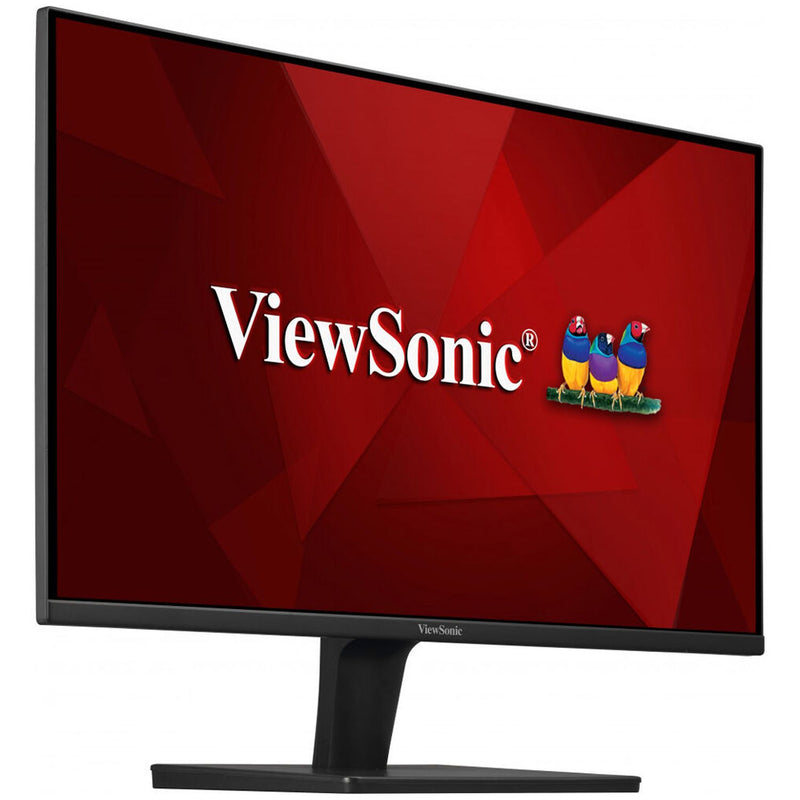
On the desktop, the same colour-science reasoning applies at a smaller scale. The ViewSonic 32-inch 4K UHD IPS monitor with 65 W USB-C and HDR10 is the most broadly useful panel we stock for detailed work — IPS for viewing-angle stability, one cable for video, data and laptop charging, 361 units on hand. And for anyone working from two locations, the ViewSonic 15.6-inch UHD OLED portable monitor brings genuinely emissive per-pixel contrast to a travel-sized second screen, with over a thousand units in stock. If you are specifying a display for a specific room, lighting condition or operating schedule, request a free quote from our team — getting the duty cycle right at purchase costs nothing and saves a replacement.

3. A Record Patch Tuesday: The Arithmetic of Vulnerability at Scale

A padlock resting on a laptop keyboard with coloured light trails, illustrating cyber security
Patch management is the least glamorous and most effective security control most organisations have. Photo: FlyD / Unsplash.

On Tuesday, September 8, Microsoft shipped the largest security update in the company's history. Counts vary slightly between trackers depending on whether third-party and republished CVEs are included — BleepingComputer reports 966 flaws, while other outlets count 973 or 974 — but the order of magnitude is not in dispute, and neither is the important detail: roughly 105 were rated Critical, 81 of those were remote code execution flaws, and two were already being exploited in the wild before a fix existed.

For context, a typical Patch Tuesday over the past several years has ranged from roughly 60 to 150 CVEs. A month approaching a thousand is a different category of event, and it deserves explanation rather than alarm.

What a CVE is, and why the count exploded

A CVE — Common Vulnerabilities and Exposures identifier — is not a measure of danger. It is a catalogue number, assigned so that everyone in the industry can refer to the same specific flaw unambiguously. Severity is conveyed separately, usually by a CVSS score from 0 to 10 built from factors like whether the attacker needs local access, whether authentication is required, and what the flaw grants if exploited.

A near-thousand-CVE month is therefore not necessarily a sign that software got dramatically worse in thirty days. Several forces inflate the count simultaneously. Automated vulnerability discovery — fuzzing at scale, and increasingly machine-learning-assisted code analysis — finds classes of bugs far faster than humans reading code ever did, and it finds them in families: one flawed parsing routine reused across twenty components produces twenty identifiers. Bug bounty programmes have professionalised, so more findings get reported rather than sat on. And a vendor's attack surface is now enormous: an operating system, a browser, a cloud platform, developer tooling, an office suite and firmware all roll up into one monthly bundle.

The two that actually matter this month

Among nearly a thousand identifiers, the meaningful triage signal is exploitation status, not severity score. A theoretical 9.8 that requires an attacker to already hold administrative credentials is less urgent than a 7.5 that someone is using against real networks this week.

Two zero-days — flaws exploited before a patch existed — are in this month's set, and they are the reason this cannot wait for the next quarterly cycle. Reported alongside them is CVE-2026-73009, a Critical remote code execution flaw in the Windows Secure Socket Tunneling Protocol service, in which an unauthenticated attacker can execute code on a target system. The phrase to focus on is unauthenticated: no stolen password, no phishing click, no user interaction. If the service is reachable, the attacker can attempt it. Separately, CISA has flagged active exploitation of CVE-2026-20079, a Cisco vulnerability originally disclosed in March 2026, and directed United States federal civilian agencies to apply fixes by September 12 — a useful signal for private organisations too, since CISA's deadlines track observed attacker activity.

Elsewhere in the same week, attackers began exploiting an unpatched remote code execution vulnerability in Magento Open Source and Adobe Commerce on September 4, allowing malicious code to run on a storefront's server without logging in. For any business running its own commerce infrastructure, that is a same-day concern.

Why patching is hard, and why deferral compounds

If the fix is free, why does anyone delay? Because a patch is a code change, and code changes carry regression risk. The organisations that suffer most from patch deferral are usually not careless; they are running software that broke once during an update and have been cautious ever since.

The problem is that risk compounds in the wrong direction. An exposed unpatched system does not merely stay as risky as it was — it gets riskier daily, because publication of the patch is itself an attack enabler. Security researchers and attackers alike perform patch diffing: comparing the patched binary against the previous version to see precisely which instructions changed, then working backwards to reconstruct the flaw. Functional exploits for widely deployed software frequently appear within days of a fix. The window between patch release and exploit availability is the window you are operating in.

There is a second-order effect worth naming, and it connects directly to the first story in this article. Gartner expects PC lifetimes to lengthen by 15% for business buyers and 20% for consumers by the end of 2026 as memory costs push replacement out, and the firm explicitly flags the consequence: delayed upgrades raise concerns over security vulnerabilities and the difficulty of managing older devices. An ageing fleet is a security problem, not only a productivity one — older machines fall out of firmware support, lack current hardware security features, and eventually reach an operating system end-of-support date after which no patch arrives at all.

A practical posture

You do not need an enterprise security operations centre to handle a month like this one. You need a small number of habits applied consistently.

Separate the emergency from the backlog. Patch the actively exploited items now, on whatever machines are internet-reachable. Schedule the rest into your normal maintenance window. Treating all 966 identifiers as equally urgent guarantees paralysis.

Reduce exposure rather than only patching it. A remote code execution flaw in a network service is only reachable if the service is listening on a reachable interface. Disabling protocols you do not use — the SSTP VPN service being a good example for most small organisations — removes the risk permanently rather than resetting the clock each month.

Know what you have. The most common reason an organisation misses a critical patch is that nobody knew the affected system existed. A current inventory of machines, operating system versions and exposed services is the foundation everything else rests on.

Prefer hardware with current platform security. Modern business notebooks ship with a TPM 2.0 module for hardware-backed key storage, firmware-level protections such as secure and measured boot, and virtualisation-based security that isolates credentials from the running operating system. These are not marketing checkboxes — they raise the cost of an attack independently of whether a given month's patches have landed. Every business-class notebook we listed earlier, including the ThinkPad T16 Gen 4 and the Surface Laptop 7, is built on that foundation. If you are weighing whether to refresh an ageing fleet or stretch it another year, that is exactly the kind of trade-off we are happy to work through with you — request a free quote from our team and we will help you cost it out honestly, including the option of not replacing everything at once.

Connecting the Threads: Arm, Foldables and the Shape of 2027

Three shorter observations tie the week together.

At Hot Chips 2026, Arm revealed its AGI data-centre CPU — notable less for its specifications than for the fact that Arm, historically a licensor of designs, is now selling complete silicon. The design is a dual-chiplet part on TSMC's N3P process, offered in 64-, 128- and 136-core Neoverse V3 configurations at a 300 W thermal design power. Unusually, Arm placed compute and I/O on the same die rather than separating them, reportedly to achieve sub-100-nanosecond DRAM latency and up to 844.8 GB/s of memory bandwidth using DDR5-8800. Of six CPU papers on the conference's first day, Arm architecture was central to four, including IBM's future Z and LinuxONE processor, NVIDIA's 88-core Vera, and FUJITSU-MONAKA.

The reason is instructive: agentic AI shifts work back to the CPU. When a model stops answering questions and starts planning, retrieving data, invoking tools and running code, the surrounding orchestration — moving data, managing memory, coordinating services, keeping accelerators fed — is serial, latency-sensitive CPU work. That is why Arm's design prioritised memory latency and bandwidth over raw core count, and it is why single-thread performance is fashionable again. On the client side, the same Arm architecture is well represented in Windows notebooks; the Lenovo IdeaPad Slim 3 with Qualcomm Snapdragon X is the accessible entry point we stock, with 16 GB of memory, a 512 GB SSD and 62 units available.

Meanwhile, Apple's September 9 event made the foldable form factor unambiguously mainstream, introducing the company's first folding iPhone alongside the iPhone 18 Pro and 18 Pro Max, with pre-orders opening September 12 and general availability from September 18. Reported changes to the Pro models — a variable-aperture main camera, a smaller Dynamic Island and Apple's in-house C2 cellular modem — are evolutionary. The foldable is not. Its engineering challenges are genuinely hard: a polyimide or ultra-thin-glass substrate that survives hundreds of thousands of fold cycles, a hinge that distributes bend radius so no single point of the display takes concentrated strain, and a neutral-axis stack-up that places the fragile emissive layer where the material neither stretches nor compresses as it bends.

If you want to understand that engineering by holding it, the Samsung Galaxy Z Fold7 is the mature expression of it — an 8-inch flexible Dynamic AMOLED 2X panel at 2184 × 1968, 12 GB of RAM, 512 GB of storage and Android 16. It is the only smartphone we currently have in stock and we have exactly one unit, so treat that as a genuine scarcity note rather than a sales line.

Finally, Qualcomm's notification to partners of double-digit price increases effective September 1, with severe semiconductor and memory constraints cited as the cause, tells you that cost pressure has spread beyond memory into logic. The Snapdragon Summit on September 22–24 will set expectations for 2027 mobile and PC silicon. Read the pricing commentary around it as carefully as the performance claims.

Glossary of the Week

Term Definition
DRAM Dynamic Random-Access Memory. Main system memory. Each bit is charge on a capacitor guarded by one transistor; because the charge leaks, the chip must continuously refresh itself, and contents are lost when power is removed.
LPDDR5X Low-Power Double Data Rate memory, generation 5X. The soldered, power-efficient DRAM used in phones, tablets and thin notebooks. Reported up roughly 89% in contract price during Q2 2026.
HBM High Bandwidth Memory. A vertical stack of DRAM dies connected by through-silicon vias, delivering very high bandwidth at low energy per bit. The component AI accelerators consume, and the reason consumer memory supply is constrained.
Through-silicon via (TSV) A microscopic conductive column etched straight through a silicon die so that stacked chips can communicate vertically over micrometres rather than routing signals around the package.
Hybrid bonding A packaging technique that joins two dies directly copper-pad to copper-pad without solder bumps, shortening chip-to-chip connections and increasing interconnect density, bandwidth and energy efficiency.
NAND flash Non-volatile storage that retains data without power by trapping charge in a cell. Modern 3D NAND stacks cells vertically across hundreds of layers.
TLC / QLC Triple-Level Cell and Quad-Level Cell flash, storing three or four bits per cell by distinguishing eight or sixteen charge levels. More bits per cell means lower cost per gigabyte but narrower voltage margins, slower sustained writes and fewer endurance cycles.
Bill of materials (BOM) The total component cost of building a device. Gartner expects PC memory to peak at about 23% of BOM in 2026, up from 16% in 2025.
Quantum dot A semiconductor nanocrystal a few nanometres across. Quantum confinement makes its emission wavelength depend on its physical size, producing very narrow-band, highly saturated colour.
Micro RGB A backlight architecture using independently driven red, green and blue LEDs smaller than 100 micrometres, replacing blue LEDs plus a colour-conversion layer and enabling per-zone control of both brightness and colour.
Local dimming / blooming Dividing a backlight into independently controlled zones to deepen blacks. Blooming is the residual halo around bright objects, caused by a dimming zone being larger than a pixel.
Emissive display A display where each pixel generates its own light (OLED, micro LED), allowing pixels to switch fully off. An LCD, however advanced its backlight, is not emissive at the pixel level.
Nit (cd/m²) A unit of luminance. Sustained full-field nits matter more than peak-window nits for displays in bright rooms or long-duty-cycle commercial use.
CVE Common Vulnerabilities and Exposures identifier — a unique catalogue number for a specific flaw. It identifies, it does not rank.
CVSS Common Vulnerability Scoring System. A 0–10 severity score derived from factors such as required access, required privileges and resulting impact.
Zero-day A vulnerability being exploited in the wild before a patch exists. Exploitation status, not severity score, is the primary triage signal.
Remote code execution (RCE) A flaw allowing an attacker to run arbitrary code on a target machine. When it requires no login, it is described as unauthenticated RCE — the most serious common class.
Patch diffing Comparing a patched binary with its predecessor to identify what changed and reconstruct the underlying flaw. The reason exploits often appear within days of a fix.
TPM 2.0 Trusted Platform Module. A hardware component that stores cryptographic keys and measures boot integrity, underpinning disk encryption and platform attestation on modern business PCs.
NPU Neural Processing Unit. An accelerator for machine-learning inference on-device. Its practical ceiling is usually available memory, since model weights must fit in memory to run at speed.
Neoverse V3 Arm's high-performance server CPU core, used in the 64-, 128- and 136-core configurations of Arm's AGI data-centre processor announced at Hot Chips 2026.
Agentic AI AI systems that plan, retrieve information, call tools and take actions rather than only generating responses — shifting a significant share of the work onto latency-sensitive CPU orchestration.

Setup at a Glance

Use case Device Why it fits
Memory-proof workstation Lenovo ThinkPad P16s Gen 4 — 32 GB / 1 TB (in stock) The exact RAM-and-storage combination the memory shortage is making scarce, bought before the next price step. 93 units on hand.
Portable 32 GB workstation Lenovo ThinkPad P14s Gen 6 — 32 GB / 512 GB (in stock) Same memory headroom for local AI and heavy multitasking in a 14-inch touchscreen chassis. 240 units.
Mainstream business notebook Lenovo ThinkPad T16 Gen 4 — 16 GB / 512 GB (in stock) The balance point for office work: 16 GB floor, 512 GB storage, full platform security. 71 units.
Premium ultraportable with NPU Microsoft Surface Laptop 7 13.8-inch — Core Ultra 7, 32 GB / 512 GB (in stock) Generous soldered memory plus on-device AI acceleration in a 13.8-inch touchscreen. 33 units.
Arm-based Windows laptop Lenovo IdeaPad Slim 3 — Snapdragon X, 16 GB / 512 GB (in stock) The accessible way into the Arm client platform now reshaping data-centre and client design alike. 62 units.
Volume office deployment Lenovo ThinkPad E16 Gen 3 — 16 GB / 256 GB (in stock) Deepest stock we hold at 417 units for cost-controlled rollouts. Plan around the 256 GB drive.
Tablet built to last Samsung Galaxy Tab S10 FE — 8 GB / 128 GB (in stock) 4 nm Exynos 1580 with memory soldered for life — so take the higher tier now. 410 units.
Budget tablet Samsung Galaxy Tab A11+ — 6 GB / 128 GB (in stock) Keeps 128 GB of storage at the entry price point that memory inflation is squeezing hardest. 445 units.
Foldable flagship phone Samsung Galaxy Z Fold7 — 12 GB / 512 GB (in stock, 1 unit) Mature flexible-AMOLED engineering in the week the foldable category went fully mainstream.
Meeting room / retail display Samsung 55-inch Crystal UHD Signage QBC (in stock) Right-sized 4K commercial panel for typical room viewing distances. 75 units.
High-duty-cycle signage Samsung QMC 75-inch UHD — 500 nit, IP5X, 24/7 (in stock) Sustained brightness, non-glare finish and a 24/7 rating — the specification that actually predicts longevity. 186 units.
Wall-sized installation Samsung QM85C 85-inch UHD (in stock) or LG 86-inch commercial 4K (in stock) Large-format 4K for lobbies and auditoriums. 36 and 7 units respectively.
Colour-critical desktop ViewSonic 32-inch 4K UHD IPS — 65 W USB-C, HDR10 (in stock) IPS viewing-angle stability with single-cable video, data and charging. 361 units.
Travelling second screen ViewSonic 15.6-inch UHD OLED portable monitor (in stock) Genuine per-pixel emissive contrast in a bag-sized panel over USB-C. 1,021 units.

Closing

If there is one idea to carry out of today's edition, it is that the component you never used to think about is now the one setting the price of everything. Memory has moved from the background of a spec sheet to the foreground of a purchasing decision, and it will stay there until new fabrication capacity arrives — which, on current projections, is a 2027 or 2028 story rather than a 2026 one. That argues for buying memory and storage headroom once, deliberately, rather than planning to add it later, because on most modern devices there is no later.

Everything else in this week's news rhymes with that. Micro RGB is a reminder that the biggest gains in display quality now come from controlling light more precisely rather than simply making more of it. A thousand-CVE Patch Tuesday is a reminder that the total cost of a computer includes the hours spent keeping it safe, and that an ageing fleet quietly raises that cost every year. And Arm's arrival as a silicon vendor is a reminder that the assumptions underpinning the next generation of hardware are being rewritten right now.

None of this has to be navigated alone. Whether you are sizing a single laptop, specifying a display for a room with awkward lighting, or deciding whether to refresh a fleet this quarter or next, we are glad to think it through with you — request a free quote from our team and we will give you an honest assessment, including the cases where the right answer is to wait.

Sources & Further Reading

Reporting and data in this article draw on: Gartner — "Surging Memory Costs Will Reduce Global PC and Smartphone Shipments in 2026"; TrendForce — "Memory Price Surge to Persist in 1Q26; Smartphone and Notebook Brands Begin Raising Prices and Downgrading Specs"; TrendForce — "Rising Memory Prices Weigh on Consumer Markets"; TrendForce — "NAND Flash 'Dry Year' Looms as Stock-Out Risk Forces PC OEMs to Cut SSD Specs"; IDC — "Global Memory Shortage Crisis"; Tom's Hardware — "Memory price surge begins to cool as consumers hit affordability limit"; TweakTown — "DRAM prices surged by up to 89% in Q2 2026"; Samsung Newsroom — "Samsung Expands Premium Micro RGB TV Lineup for 2026"; Samsung Newsroom — "Samsung Sets a New Standard of Color with Micro RGB TV Lineup"; Trusted Reviews — "What is Micro RGB?"; BleepingComputer — "Microsoft September 2026 Patch Tuesday fixes 966 flaws, 2 zero-days"; Cyber Security News — "Massive Microsoft Patch Tuesday September 2026"; The Cyber Express — "Patch Tuesday September 2026"; CrowdStrike — "September 2026 Patch Tuesday: Updates and Analysis"; Arm Newsroom — "Hot Chips 2026: The CPU's next chapter is being built on Arm"; ServeTheHome — "Arm's AGI Data Center CPU at Hot Chips 2026"; MacRumors — "Apple's September 9 Event Preview"; 9to5Mac — "Apple announces iPhone 18 Pro and foldable iPhone event"; Android Authority — "Qualcomm notifies hardware partners of impending chip price hikes"; T3 — "The Best of IFA 2026"; and Tom's Guide — "What to expect at IFA 2026". Photos: Unsplash (free commercial license).

Product availability and stock counts were verified against PcHybrid inventory on September 11, 2026, and can change without notice.

En savoir plus →

Tech Science Daily — September 7, 2026: Why Your Next Laptop Costs More (The DRAM Squeeze), the 2nm Gate-All-Around Era, and a Rough Week for Browsers and Routers

PcHybrid
Montreal, September 7, 2026. Three deep dives: the physics and economics behind the DDR5 price shock, TSMC's move from FinFET to gate-all-around nanosheets at 2nm, and the week's browser and router vulnerabilities — plus in-stock buying advice from PcHybrid.

En savoir plus →

Tech Science Daily — September 5, 2026: Micro RGB Backlights, 80-TOPS NPUs, and the Langflow Wake-Up Call

PcHybrid
IFA 2026 in Berlin, the Snapdragon X2 Elite 80-TOPS NPU, and a critical Langflow RCE under mass exploitation — the science behind this week's three biggest tech stories, plus in-stock buying guidance from PcHybrid.

En savoir plus →

Tech Science Daily — September 1, 2026: Micro RGB Backlights, the HBM4 Memory Wall, and the 2 nm Gate-All-Around Era

PcHybrid
Micro RGB backlights reach six screen sizes, HBM4 enters mass production while consumer DRAM keeps climbing, and TSMC's N2 node brings gate-all-around transistors to shipping products. The science behind three stories that decide what your next screen, laptop or phone can actually do.

En savoir plus →

Tech Science Daily — August 31, 2026: Maskless OLED, 300Hz Laptop Screens and the Windows Kernel Zero-Day Everyone Missed

PcHybrid

Montreal, Monday August 31, 2026. The last week of August is usually a quiet stretch in consumer technology — the lull before IFA opens in Berlin on September 4. This year it was anything but. Two of the three companies that manufacture nearly every premium screen you will ever look at used the International Meeting on Information Display (IMID 2026) in Busan, South Korea, to unveil work that changes how OLED panels are made and how fast they can be driven. Meanwhile, the security community spent the month digesting the largest Patch Tuesday Microsoft has ever shipped, anchored by a single small memory-management bug in a Windows networking driver that attackers were already exploiting.

These stories look unrelated. They are not. Each one is a case of an engineering constraint that held for a decade finally breaking — a stencil that could not get smaller, a refresh ceiling that could not get higher, a driver whose locking model could not keep up with modern multi-core scheduling. Today we walk through the physics and the engineering behind three of them, in plain language, and then translate each into something useful: what it means for the device you are about to buy, and what it does not mean.

As always, this is a science column first and a shopping column second. We do not repeat marketing claims we cannot source, and where a manufacturer has withheld a specification, we say so explicitly rather than filling the gap with a guess.

Today's Tech Radar

Here are the ten most consequential technology stories of the past few weeks, ranked by how much they change the underlying engineering rather than by how loudly they were announced.

# Story Why it matters
1 LG Display unveils FLiPP, an OLED patterning process that eliminates the fine metal mask Removes the single biggest physical constraint on OLED resolution, panel size and cost. Claimed 1.6× brightness, 2.4× lifespan, 13% lower power versus mask-made panels under identical conditions.
2 Samsung Display shows the world's first 300Hz OLED laptop panel (16-inch, 2.5K) Breaks the 240Hz ceiling that has held for laptop OLED, bringing desktop-monitor motion clarity into a portable chassis.
3 Microsoft's August Patch Tuesday fixes 421 CVEs, including actively exploited zero-day CVE-2026-68820 A use-after-free in the WinSock kernel driver (AFD.sys) that hands a local attacker SYSTEM privileges. Added to CISA's Known Exploited Vulnerabilities catalog with an August 25 remediation deadline.
4 Samsung Display also demonstrates 4K 360Hz 31.5-inch QD-OLED and a 34-inch 21:9 360Hz ultrawide Signals that the high-refresh QD-OLED desktop panel is moving from halo product to mainstream catalogue item.
5 Cl0p ransomware group lists 40+ organisations from a campaign against PTC Windchill and FlexPLM Another mass-exploitation campaign against a managed file/product-lifecycle platform rather than endpoints — the supply-chain pattern continues.
6 FBI, CISA and HHS update their Medusa ransomware advisory: 500+ victims as of April 2026 Up from roughly 300 in March 2025. Healthcare and hospital systems remain frequent targets.
7 AMD introduces Helios, a rack-scale AI platform pairing Epyc 9006 CPUs with Instinct MI455X GPUs A single-vendor answer to Nvidia's rack-scale systems, competing on compute density, memory and tokens-per-dollar rather than raw peak FLOPS.
8 AWS announces Trainium 3 and Inferentia 4, with hardware acceleration for Mixture-of-Experts models Custom silicon is now being shaped around a specific model architecture, not just around generic matrix multiplication.
9 TSMC scales advanced capacity in Arizona, ramping 2nm alongside 3nm and 5nm plus packaging Leading-edge logic and advanced packaging both moving onshore changes lead times and supply risk for everything downstream.
10 Samsung Display shows a 7.6-inch foldable OLED panel with a wider viewing angle Addresses the off-axis brightness and colour shift that has been foldables' most persistent optical weakness.

Three of these have enough scientific substance — and enough practical relevance to what you might actually buy — to deserve a full treatment. We take them in order.

1. LG Display's FLiPP: what happens when you throw away the stencil

A large flat-screen television mounted above a minimalist wooden stand in a living room
FLiPP is aimed first at tablets and monitors, with large-screen televisions as the long-term destination. Photo: JALG TV Stand / Unsplash.

How an OLED pixel is normally built

To understand why LG Display's announcement at IMID 2026 matters, you have to understand how an OLED display is physically assembled — and it is stranger than most people assume.

An OLED pixel is a sandwich. At the bottom sits a thin-film transistor backplane that controls how much current reaches each subpixel. On top of that, a stack of organic layers is deposited: a hole-injection layer, a hole-transport layer, an emissive layer doped with the molecule that actually produces light, an electron-transport layer, and finally a cathode. When current flows, electrons and holes meet in the emissive layer, form a bound state called an exciton, and that exciton relaxes by emitting a photon. The colour of that photon is set by the chemistry of the emitter molecule, not by a filter. This is the reason OLED can produce a true black: a pixel that receives no current emits nothing at all, so contrast is limited only by ambient reflection.

The difficulty is the word "deposited." Those organic layers are not printed or etched in the way that silicon features are. They are evaporated: the organic material is heated in a vacuum chamber until it sublimes, and the vapour condenses onto the cooled glass substrate above. That is a perfectly good way to lay down a uniform film. It is a terrible way to lay down three different films — red, green and blue — in a precise interleaved pattern, because vapour goes everywhere.

The industry's answer for nearly two decades has been the fine metal mask, or FMM. An FMM is an extremely thin sheet of nickel-iron alloy perforated with millions of microscopic holes, held taut a hair's breadth above the substrate. Red vapour is evaporated through a mask whose holes sit over the red subpixel positions; the mask is swapped, and the process repeats for green and blue. It is, as LG Display itself put it in describing the contrast with its new method, essentially a stencil technique.

Why the stencil became the bottleneck

Stencils have physics problems, and they get worse as you scale.

The first is shadowing. The mask must be held slightly away from the substrate so it does not scratch the delicate organic film. But vapour arriving at an angle passes through a hole and lands slightly outside the intended footprint, blurring the edge of every subpixel. To keep colours from bleeding into one another, designers must leave dead space between subpixels. That dead space directly reduces the fraction of the panel's area that actually emits light — the aperture ratio — which in turn means each emitting region must be driven harder to hit a given screen brightness.

The second is sag. A metal foil tens of micrometres thick, stretched across a large sheet of glass, droops under its own weight. The bigger the sheet, the worse the droop, and the worse the alignment between the mask holes and the transistors underneath. This is the fundamental reason smartphone-class RGB OLED has historically been made on relatively small mother glass while large televisions used a completely different architecture — a white OLED emitter with colour filters — which throws away a great deal of light at the filter stage.

The third is utilisation. Because masks cannot be made arbitrarily large without sagging, manufacturers cut mother glass into smaller working areas, and the offcuts around the edges are waste. In an industry where the substrate and the cleanroom time are the dominant costs, wasted glass is wasted money.

The combined result is a hard ceiling. Higher pixel density requires smaller holes; smaller holes worsen shadowing and reduce aperture ratio; lower aperture ratio requires higher drive current; higher drive current accelerates the degradation of the organic emitter — particularly the blue one, which is the shortest-lived because blue photons carry the most energy and the excited states that produce them are the most chemically destructive to their host molecules. Every gain fights every other gain.

What FLiPP actually does differently

FLiPP stands for FMM-Less innovative Pixel Patterning, and LG Display describes it as the product of roughly a year of concentrated development, shown publicly for the first time at IMID 2026 in Busan.

Instead of patterning during deposition, FLiPP separates the two steps. The red, green and blue organic materials are coated in sequence across the substrate, secured in precise positions, and then photolithography — precision ultraviolet light etching — is used to remove the unnecessary material, leaving each colour only where it belongs. In other words, the pattern is defined after the film is laid down, by light, rather than during deposition, by a physical stencil.

If that sounds like how semiconductors have been patterned since the 1960s, that is exactly the point. Photolithography's resolution is set by optics and chemistry, not by how small a hole you can punch in a metal foil or how flat you can keep it. The historical obstacle was never the idea; it was that organic emitter materials are chemically fragile and dislike the solvents and developers that lithography traditionally requires. Solving that materials problem is the actual achievement here.

The numbers LG Display reports, comparing FLiPP panels with FMM panels produced under identical conditions, are these: 1.6 times the brightness, 2.4 times the panel lifespan, and 13 percent lower power consumption. Separately, because there is no sagging mask to constrain the working area, FLiPP can pattern across an entire 8.5-generation mother glass substrate, which the company says improves mother-glass utilisation by up to 64 percent versus methods that use FMMs or require divided substrates.

Why those three numbers are really one number

It is tempting to read 1.6× brightness, 2.4× lifespan and −13% power as three separate wins. They are better understood as three views of the same underlying change: a larger fraction of the panel emits light.

Remove shadowing and you can shrink the dead space between subpixels, raising the aperture ratio. A higher aperture ratio means that to produce a given number of candelas per square metre at the screen surface, each square micrometre of emitter runs at a lower current density. Lower current density is the single most important variable in OLED longevity, because the degradation mechanisms — exciton-polaron annihilation, and the chemical breakdown of host and dopant molecules under sustained excitation — scale superlinearly with it. Run the same material gentler and it lasts disproportionately longer. Lower current density also means less resistive loss in the drive circuitry, which is where a meaningful part of that 13 percent power saving comes from.

So the honest summary is: FLiPP does not invent a brighter emitter molecule. It gives the existing emitter more room to work, and then lets you spend that headroom on whichever axis you care about — peak brightness for HDR, longevity for a display that will show a static interface for eight hours a day, or battery life for a tablet.

Industry context: who this pressures

LG Display says it will apply FLiPP first to IT products such as tablets and monitors, then expand to wearables and eventually large-screen televisions. That ordering is revealing. Tablets and monitors are the segment where RGB OLED is currently most expensive to make and where the incumbent alternative — LCD with a mini-LED backlight — is still genuinely competitive on brightness and cost. It is also, not coincidentally, the segment where Samsung Display has been investing heavily in tandem OLED structures.

That competitive picture is worth stating plainly, because the two companies are attacking the same problem from opposite directions. Tandem OLED stacks two complete emitting units in series within a single pixel, so the same current passes through both and produces roughly twice the photons. It is a brute-force solution: effective, proven, already shipping, but it doubles the organic material cost and the process complexity. FLiPP instead makes a single emitting unit more efficient by removing the geometric penalty of the mask. If FLiPP's claims hold up in volume production, it reaches a comparable destination with less material.

There is a caveat we should not skip. Everything above is drawn from a technology demonstration and the manufacturer's own comparative measurements at a trade conference. Yield in volume production is a different and much harder question, and LG Display has not published a commercial timeline. Historically, the gap between an IMID demonstration and a shipping product has run two to four years. Treat FLiPP as a credible direction of travel, not as a reason to postpone a purchase.

What this means if you are buying a screen this year

The practical conclusion is almost the opposite of what an announcement like this usually produces. FLiPP is not going to appear in anything you can buy in 2026, and the panels that will reach the market first are tablets and monitors — not televisions and not large-format displays. If your requirement is a large screen now, the mature technology is the right purchase, and the relevant specifications are the ones that determine whether the panel survives your duty cycle.

This is where the distinction between a consumer television and a commercial display becomes the important one, and it is routinely misunderstood. A consumer TV is engineered for a few hours a day of varied content. A commercial display is engineered for a defined operating duty, a specified sustained brightness, and ingress protection against dust. Our Samsung 55" Crystal UHD Signage QBC (in stock) is a 4K panel built for that kind of continuous service, which makes it a sensible choice for a meeting room, a lobby or a classroom where a consumer set would be run well outside its design envelope. For a genuinely large installation, the Samsung QM85C 85-inch UHD display (in stock) is rated at 500 nits with a non-glare finish, an IP5X dust rating and a 24/7 operating duty — specifications that exist precisely because the failure modes discussed above are real and cumulative.

On the desktop, the FLiPP story is a reminder that ultrawide geometry buys you working area that a higher pixel density on a small panel does not. The Samsung S34C504 34-inch 21:9 ultrawide with HDR-10 (in stock) gives you two documents genuinely side by side without a bezel down the middle — a more reliable productivity gain than any panel-technology upgrade of the last five years.

And for the tablet category that FLiPP targets first, the sensible move is to buy for the silicon and the software support window rather than for a panel technology that is not shipping yet. The Samsung Galaxy Tab S10 FE (in stock) runs an Exynos 1580 built on a 4nm process with 8GB of memory — a specification that will still be comfortable when maskless OLED tablets finally arrive. If you need cellular independence for field or site work, the Galaxy Tab S10 FE 5G (in stock) is the same platform with a modem. If you are unsure which panel class actually suits your room, its ambient light and its duty cycle, you can request a free quote from our team and we will size it against the space rather than against a spec sheet.

2. Samsung Display's 300Hz OLED laptop panel: the physics of motion clarity

A gaming laptop with illuminated keyboard on a desk in a dark room
High-refresh OLED is arriving in the laptop chassis, but the specifications that matter most are still undisclosed. Photo: Sharad kachhi / Unsplash.

What was actually shown

At the same Busan conference, Samsung Display demonstrated what it describes as the world's first 300Hz OLED laptop panel: a 16-inch display at 2.5K resolution in a 16:9 aspect ratio, with a variable refresh rate reaching up to 300Hz, aimed at high-end gaming laptops.

Two things about the reporting are worth flagging before we go further, because they set the boundary of what can honestly be said. First, laptop OLED has been capped at 240Hz until now, a ceiling that high-refresh LCD gaming laptops cleared some time ago. Second — and this is the part that most coverage glossed over — Samsung's own booth signage identified the panel only as "16" WQ OLED 300Hz." The company has not disclosed its brightness, its HDR certification, its response time or its exact pixel resolution, and it has not said which laptops will use it or when. We are therefore going to explain what 300Hz does and does not do, and leave the unpublished specifications alone.

Refresh rate is not the same thing as motion clarity

The most common misunderstanding about high-refresh displays is that the benefit comes from seeing more frames. It contributes, but it is the smaller half of the story. The larger half is a property called persistence, and it is a consequence of how nearly every modern flat panel works.

OLED and LCD panels are both sample-and-hold displays. Each frame is written to the panel and then held, illuminated and unchanging, for the full duration of that frame's refresh interval. A CRT, by contrast, illuminated each phosphor for a fraction of a millisecond as the electron beam swept past, leaving the screen dark most of the time.

Now consider what your eye does while tracking a moving object. Your eyes perform a smooth pursuit movement, gliding at roughly the same velocity as the object so its image stays fixed on your fovea. But the object on a sample-and-hold display is not moving smoothly. It sits perfectly still for one whole frame, then jumps to a new position. Your eye, moving smoothly, sweeps across that stationary image for the entire frame duration — and your retina integrates that sweep into a smear. This is eye-tracking motion blur, and the crucial point is that it is generated inside your visual system, not by the panel. A display with a theoretically instantaneous pixel response can still look blurry in motion.

The width of the smear is, to a good first approximation, the object's velocity multiplied by the frame hold time. That gives a clean way to think about refresh rate:

Refresh rate Frame hold time Blur width for an object crossing at 1000 px/s
60Hz 16.7 ms ~16.7 pixels
120Hz 8.3 ms ~8.3 pixels
240Hz 4.2 ms ~4.2 pixels
300Hz 3.3 ms ~3.3 pixels

Read down that column and the diminishing returns are obvious. Going from 60Hz to 120Hz removes about 8.4 pixels of smear. Going from 240Hz to 300Hz removes about 0.9. The first step is transformative; the last is a refinement that a trained competitive player may perceive and most people will not.

So why does OLED at 300Hz matter more than LCD at 300Hz?

Because persistence blur is only one of two blur sources, and OLED has already eliminated the other one.

An LCD pixel does not switch instantly. It changes state by physically reorienting liquid crystal molecules, a process that takes milliseconds. During that transition the pixel displays intermediate, wrong colours — the familiar grey-to-grey smearing and, when overdrive is applied too aggressively to compensate, the bright fringing artefact known as inverse ghosting. At 300Hz, an LCD has 3.3 milliseconds to complete a transition, and many LCD transitions — particularly dark-to-dark ones — simply cannot finish in that window. The panel accepts 300 frames per second but cannot fully render them.

An OLED subpixel is an electrically driven emitter. Its transition time is measured in microseconds, three orders of magnitude faster than the frame interval. It genuinely finishes each frame. So an OLED at 300Hz delivers close to the theoretical persistence limit for that refresh rate, whereas an LCD at 300Hz delivers a compromised version of it. That is why this panel is more interesting than the number alone suggests: it is not that 300 is much better than 240, it is that on OLED the number means what it says.

The variable-refresh part deserves equal billing

Samsung specified a variable refresh rate up to 300Hz, and in day-to-day use that is arguably the more valuable half.

On a fixed-refresh display, the panel scans on its own clock while the graphics processor finishes frames whenever it finishes them. When the two disagree — which is almost always — you get one of two failures. Without synchronisation, a new frame arrives mid-scan and the top of the screen shows one frame while the bottom shows the next: tearing. With traditional vertical synchronisation, the GPU waits for the next refresh boundary, so a frame that misses its deadline by a fraction of a millisecond is displayed a full interval late, producing a visible stutter and adding input latency.

Variable refresh rate inverts the relationship. The display waits for the GPU. Each frame is shown as soon as it is ready, and the refresh interval stretches or compresses to match. Tearing disappears without the latency penalty of vertical synchronisation, and frame-rate fluctuations — which are the norm on a laptop, where thermal and power limits cause continuous variation — stop translating into visible judder.

For a portable machine there is a second benefit that matters more than the gaming case. A display that can drop its refresh rate when content is static is a display that stops burning power redrawing an unchanging spreadsheet 300 times a second. On a laptop, the panel is typically among the top two or three consumers of battery, and variable refresh is one of the few genuinely free efficiency wins available.

Industry context: the aspect ratio is the surprise

One detail in the reporting deserves comment. The panel is 16:9. Nearly every premium laptop of the last five years has moved to 16:10 or 3:2, because taller panels show more lines of text, more spreadsheet rows and more code. Choosing 16:9 for a 16-inch panel is a deliberate signal that this is a gaming part first: 16:9 remains the native aspect ratio for the overwhelming majority of games and for full-screen video, and it avoids the letterboxing that a taller panel introduces.

The broader trend is unmistakable. Samsung Display showed this laptop panel alongside a 31.5-inch 4K 360Hz QD-OLED and a 34-inch 21:9 360Hz ultrawide for desktop monitors. High-refresh OLED is moving from a specialty item to a full product line across sizes. LG Display, at the same conference, was showing the manufacturing process that could eventually make all of it cheaper. These are complementary halves of the same industry shift.

Practical buying advice: what to do with this today

Samsung has not named a launch partner or a date, so no shipping laptop has this panel. That makes the useful advice about what to prioritise in a machine you buy now.

Be honest about the workload. If you are not playing competitive first-person games, the difference between 240Hz and 300Hz is not a specification you will ever perceive, and money spent there is money not spent on memory, storage or a better keyboard — all of which you will notice every day. The three specifications that actually determine whether a laptop still feels good in year three are memory capacity, sustained thermal performance, and the presence of a neural processing unit for the on-device inference that is steadily migrating out of the cloud.

For a large-screen machine where a 16-inch panel is the point, the Lenovo ThinkPad T16 Gen 4 (in stock) pairs a 16-inch WUXGA display with an AMD Ryzen AI 7 PRO 350, 16GB of memory and a 512GB SSD. The Ryzen AI designation matters here for a concrete reason: it denotes an integrated NPU meeting the Copilot+ performance threshold, which means the local inference workloads that Windows is progressively offloading to hardware run on dedicated silicon instead of stealing CPU cycles and battery.

If portability outranks screen size, the Microsoft Surface Laptop 7 13.8-inch (in stock) is configured with an Intel Core Ultra 7 and, notably, 32GB of memory — the specification most likely to extend a laptop's useful life, since memory is the one component you cannot add later on a modern thin-and-light. For a lighter budget with the same generational advantages, the Lenovo IdeaPad Slim 3 15.3-inch (in stock) runs a Qualcomm Snapdragon X with 16GB and 512GB, and Arm-based Windows laptops currently hold a clear advantage in idle power draw — which is where a laptop spends most of its day. And if the foldable form factor is what interests you, Samsung's IMID demonstration of a wider-viewing-angle 7.6-inch foldable panel is aimed squarely at the off-axis colour shift you can see for yourself on the Samsung Galaxy Z Fold7 (in stock, limited quantity) with its 8-inch Dynamic AMOLED 2X inner display.

3. CVE-2026-68820: how a synchronisation bug becomes a total system compromise

A padlock resting on a laptop keyboard with coloured light trails around it
A single memory-management flaw in a networking driver was enough to hand attackers SYSTEM privileges. Photo: FlyD / Unsplash.

The scale of the August update

Microsoft's August 2026 Patch Tuesday addressed 421 CVEs — an extraordinary figure by any historical standard. But volume is a poor measure of risk. Of those hundreds of issues, exactly one was confirmed to be under active exploitation before the patch existed: CVE-2026-68820, an elevation-of-privilege vulnerability in the Windows Ancillary Function Driver for WinSock, better known by its filename, AFD.sys. It carries a CVSS score of 7.0 and a severity rating of Important — and it is a useful reminder that CVSS scores measure characteristics, not consequences.

CISA added it to the Known Exploited Vulnerabilities catalog with a remediation deadline of August 25, 2026. Reporting has attributed the observed exploitation to North Korea's Lazarus Group.

What AFD.sys is and why it is a target

When an application on Windows opens a network socket, it does not talk to the network card. It calls into the WinSock API in user space, which routes the request through AFD.sys — a kernel-mode driver that sits between the user-mode socket abstraction and the actual TCP/IP stack.

Two properties make this driver an unusually attractive target. First, it runs in kernel mode, at the highest privilege level the processor offers, where code can read and write any memory on the system. Second, and more importantly, it is reachable from unprivileged user code. Any process, running as any user, in almost any sandbox, can open a socket. Most kernel components are not reachable that way. AFD.sys is, by design, on the other side of a boundary that every program is allowed to cross.

The mechanics of a use-after-free

CVE-2026-68820 is a use-after-free, classified as CWE-416. The class is worth understanding because it accounts for a large share of the memory-safety vulnerabilities found in operating system kernels.

The kernel allocates memory objects to track state — for a socket, an object holds the connection's status, its buffers, and pointers to the functions that handle its events. When the socket is closed, that object is freed and its memory returned to the allocator pool for reuse.

A use-after-free occurs when some other part of the code still holds a pointer to that freed memory and dereferences it. If nothing has reused the memory, the stale data is often still intact and the bug goes unnoticed — which is precisely why these flaws survive testing. But the attacker's move is to control what lands there. Immediately after triggering the free, the attacker performs operations that cause the kernel to allocate new objects of the same size, a technique called heap grooming. If one of those attacker-controlled allocations occupies the freed slot, the stale pointer now points at data the attacker wrote. When the kernel follows what it believes is a function pointer inside its own socket object, it instead follows a value the attacker chose — and executes attacker-directed code at kernel privilege.

The race condition that makes it reachable

The specific mechanism reported for this flaw is improper synchronisation when multiple threads interact with socket-related state concurrently. Under particular race conditions, one code path frees a memory object while another continues to access it.

This is the hardest category of bug to find and to fix. A kernel driver is inherently concurrent: many threads on many cores touch shared structures simultaneously, and correctness depends on locks being held over exactly the right regions of code. Miss a window of a few instructions — between the moment a reference count reaches zero and the moment a competing thread's pointer is invalidated — and you have a race. That window may be nanoseconds wide. But an attacker can attempt to hit it thousands of times per second, on a machine tuned to widen the window through CPU affinity and scheduling pressure. A one-in-a-million race, retried a million times, is a reliable exploit.

The exploitability profile follows directly: a low-privileged local attacker, no user interaction required, resulting in SYSTEM privileges.

Why "local only" is not the reassurance it sounds like

The most common misreading of a local privilege escalation is that it is a second-tier problem because the attacker must already be on the machine. In modern intrusions that gets the sequence backwards.

Contemporary attacks are built in stages. The first stage — a phishing document, a malicious npm package, a compromised browser extension, a fake recruiter attachment — typically lands with ordinary user privileges inside a sandbox. From there the attacker can read that user's files, which is bad, but cannot disable endpoint detection, cannot access other users' data, cannot install a kernel driver and cannot harvest credentials from protected memory.

An elevation-of-privilege bug in a kernel component reachable from a sandbox is precisely the bridge between those two worlds. It converts a limited foothold into complete control of the machine. The reported attribution to a campaign using fraudulent job-offer lures fits this pattern exactly: the lure obtains initial execution as the logged-in user, and the kernel bug does the rest. A local privilege escalation is not a lesser vulnerability. It is the component that makes every other stage worth the attacker's effort.

The wider August picture

Two other developments from the same period fill out the threat landscape and reinforce the same lesson.

The Cl0p ransomware group listed more than 40 organisations on its leak site as victims of a campaign targeting PTC's Windchill and FlexPLM product lifecycle management platforms, with Shell, Philips and General Electric among the named organisations. This continues a pattern Cl0p has refined over several years: rather than compromising endpoints one at a time, find a vulnerability in a platform that many large organisations run centrally, exploit it at scale, and extract data from all of them in a single campaign.

Separately, an updated joint advisory issued on August 18 by the FBI, CISA and the Department of Health and Human Services reported that Medusa ransomware actors had reached more than 500 victims as of April 2026, up from roughly 300 recorded in March 2025. Hospitals and healthcare systems remain frequent targets — a sector where the operational consequences of downtime are measured in patient outcomes rather than in revenue.

The connecting thread is that none of these campaigns depended on novel or exotic techniques. They depended on the gap between the day a patch is published and the day it is actually applied across an estate.

What to actually do about it

The remediation for CVE-2026-68820 is not clever. Apply the August 2026 Windows security update. There is no configuration change or workaround that substitutes for the patch, because the flaw is in the driver's internal synchronisation logic rather than in a feature that can be disabled.

The structural questions are more useful than the tactical one. Do you know how many Windows devices your organisation actually has? Can you confirm, rather than assume, that they received last month's update? How long does it take a critical patch to reach the last machine on your network — and do you know which machine that is?

For most small and mid-sized organisations, the honest answers are uncomfortable. Hardware refresh is one of the few genuinely effective levers, because a modern managed device with a current firmware baseline, an active support contract and a working update channel closes more risk than most security products sold to compensate for the absence of one. Business-class notebooks such as the Lenovo ThinkPad T14s Gen 6 (in stock) ship with the firmware-level management and TPM-backed attestation features that make fleet patching verifiable rather than hopeful — which is exactly the capability that turns "we think we patched" into "we can show that we patched."

If you are not certain where your fleet stands, that uncertainty is itself the finding. We can help you inventory what you have, identify which devices are outside their support window, and plan a staged refresh that does not require replacing everything at once — request a free quote from our team and we will start from your actual device list rather than from a template.

Glossary of the Week

Term Definition
AFD.sys The Windows Ancillary Function Driver for WinSock — a kernel-mode driver that connects user-space socket calls to the TCP/IP stack. Reachable from unprivileged code, which makes it a high-value target.
Aperture ratio The fraction of a display panel's surface area that actually emits light. A higher aperture ratio lets a panel reach a given brightness at lower current density, which improves efficiency and lifespan.
CVSS Common Vulnerability Scoring System. A 0–10 score describing a vulnerability's technical characteristics. It measures attributes, not real-world consequence — a 7.0 under active exploitation outranks a 9.8 that no one has weaponised.
Current density Electrical current per unit area of emitter. The dominant variable in OLED degradation: the same material driven harder degrades disproportionately faster.
Eye-tracking motion blur Smearing produced inside the viewer's visual system when the eye moves smoothly across a display that holds each frame stationary. Reduced by shortening frame hold time, not by faster pixels.
Exciton The bound electron–hole pair formed in an OLED's emissive layer. When it relaxes, it emits a photon whose colour is determined by the emitter's chemistry.
FLiPP FMM-Less innovative Pixel Patterning. LG Display's process for patterning OLED subpixels with photolithography instead of a fine metal mask.
FMM (Fine Metal Mask) A perforated metal foil used as a stencil during OLED deposition. Its shadowing and sagging behaviour have limited OLED pixel density and panel size for nearly two decades.
Heap grooming An exploitation technique in which an attacker performs carefully chosen allocations so that attacker-controlled data lands in a specific freed memory slot.
KEV catalog CISA's Known Exploited Vulnerabilities catalog — a list of flaws confirmed to be exploited in the wild, each carrying a mandatory remediation deadline for US federal agencies and serving as a de facto priority list for everyone else.
Mother glass / Gen 8.5 The large glass substrate on which displays are fabricated before being cut. "Generation" denotes its size; higher utilisation of a single sheet directly reduces cost per panel.
NPU Neural Processing Unit. A dedicated accelerator for machine-learning inference, allowing AI workloads to run locally without consuming CPU cycles or battery at the same rate.
Persistence How long a display holds each frame illuminated. Lower persistence means less motion blur; it is the primary mechanism by which higher refresh rates improve clarity.
Photolithography Patterning a material by exposing it to precisely shaped light and chemically removing the unwanted regions. Standard in semiconductor manufacturing; newly applied to OLED emitters in FLiPP.
Race condition A defect where a program's correctness depends on the relative timing of concurrent threads. In kernels, races frequently produce exploitable memory-corruption bugs.
Sample-and-hold A display behaviour in which each frame is written and then held illuminated for the entire refresh interval, as opposed to being briefly flashed. The root cause of eye-tracking motion blur.
Tandem OLED A pixel architecture stacking two complete emitting units in series so the same current produces roughly twice the light. Improves brightness and lifespan at the cost of material and process complexity.
Use-after-free (CWE-416) A memory-safety flaw in which code dereferences a pointer to memory that has already been released. If an attacker controls what reoccupies that memory, it becomes arbitrary code execution.
VRR (Variable Refresh Rate) A display mode in which the refresh interval adapts to the rendering rate, eliminating tearing without the latency cost of vertical synchronisation and reducing power on static content.

Setup at a Glance

Every device below was verified in stock at the time of writing. Stock changes daily; if something has moved, tell us what you were looking at and we will find the closest current equivalent.

Use case Device Why it fits
Large-screen main laptop Lenovo ThinkPad T16 Gen 4 (in stock) 16-inch WUXGA panel with a Ryzen AI 7 PRO 350, 16GB and 512GB. The integrated NPU keeps local AI workloads off the CPU and out of your battery budget.
Portable machine that lasts Microsoft Surface Laptop 7 13.8" (in stock) Core Ultra 7 with 32GB of memory — the specification that most reliably extends a thin-and-light's useful life, since memory cannot be added later.
Managed business fleet Lenovo ThinkPad T14s Gen 6 (in stock) Firmware-level management and TPM-backed attestation make patch compliance verifiable — the practical answer to the AFD.sys lesson.
Budget Copilot+ notebook Lenovo IdeaPad Slim 3 15.3" (in stock) Snapdragon X with 16GB and 512GB. Arm-based Windows currently leads on idle power draw, which is where a laptop spends most of its day.
Tablet for reading and field work Samsung Galaxy Tab S10 FE (in stock) 10.9-inch WUXGA+ with a 4nm Exynos 1580 and 8GB. Buy for the silicon and support window, not for a panel technology that has not shipped.
Tablet with cellular independence Samsung Galaxy Tab S10 FE 5G (in stock) Same platform with a 5G modem, for sites where Wi-Fi is unreliable or absent.
Meeting room or classroom display Samsung 55" Crystal UHD Signage QBC (in stock) A 4K commercial panel engineered for continuous operation, where a consumer television would run outside its design envelope.
Large-format installation Samsung QM85C 85" UHD (in stock) 500 nits, non-glare, IP5X dust rating and a 24/7 duty rating — specifications that exist because continuous-use failure modes are real.
Desktop productivity Samsung S34C504 34" ultrawide (in stock) 21:9 with HDR-10. Two documents genuinely side by side with no bezel between them — a more dependable gain than any recent panel upgrade.
Foldable flagship phone Samsung Galaxy Z Fold7 512GB (in stock, limited quantity) 8-inch Dynamic AMOLED 2X inner display, 12GB RAM, Android 16 — the form factor Samsung's new wide-viewing-angle foldable panel is designed to improve.

Closing thought

The three stories in this edition share a structure. In each case, an engineering constraint that everyone had learned to work around turned out to be removable — but only after someone spent years on the unglamorous part. Photolithography on OLED was not a new idea; making it survive contact with fragile organic emitters was the work. Driving a panel at 300Hz was not conceptually hard; getting there without sacrificing response time was. And the kernel bug is the mirror image: a constraint everyone had learned to work around, which turned out to be removable by an attacker.

That is worth holding onto when you read a specification sheet. The number on the box is the outcome of a trade-off, and knowing which trade-off tells you far more than the number does. A 300Hz panel with an undisclosed brightness figure, a display rated for 24/7 operation, a laptop with an NPU you may not use yet — each is an engineering choice about what to optimise and what to accept. The right purchase is the one whose trade-offs match your actual constraints.

If you would like help working out which those are — for a single machine, a meeting room, or a fleet due for refresh — request a free quote from our team. We will start from what you are actually trying to do, and we will tell you when the cheaper option is the better one.

Sources & Further Reading

LG Display FLiPP: PR Newswire — LG Display unveils FLiPP; TechPowerUp; The Korea Times — LG Display and Samsung Display at IMID; ecoustics. Samsung Display 300Hz OLED laptop panel and QD-OLED monitor panels: SamMobile; VideoCardz; Notebookcheck; GSMArena. CVE-2026-68820 and the August 2026 Patch Tuesday: SecurityWeek; Help Net Security; Qualys; SOC Prime. Cl0p and Medusa ransomware campaigns: eSecurity Planet; SWK Technologies; Xage. AI silicon, AMD Helios, AWS Trainium 3 and TSMC Arizona: Data Center Knowledge; AIwire. IFA 2026 context: Android Authority; VideoCardz. Photos: Unsplash (free commercial license).

En savoir plus →

Tech Science Daily — August 28, 2026: Memory That Computes, the DRAM Price Shock, and the Micro RGB Brightness Race

PcHybrid
Samsung put an arithmetic unit inside a stick of LPDDR5X and claimed 3.01x AI throughput. DRAM contract prices are up 90-95% in one quarter. And Micro RGB backlights finally stopped throwing two-thirds of their light away. A scientific look at the week's most consequential hardware news, and what it means for what you should buy.

En savoir plus →